


TRUE SOUTH AFRICA - Evidence Series: The Economy


Copyright © 2026
Inclusive Society Institute
PO Box 12609
Mill Street
Cape Town, 8010
South Africa
235-515 NPO
All rights reserved. No part of this publication may be reproduced
or transmitted in any form or by any means without the permission in
writing from the Inclusive Society Institute
DISCLAIMER
Views expressed in this report do not necessarily represent the views of
the Inclusive Society Institute or its Board or Council members.
This report was prepared with the assistance of AI technology, including ChatGPT.
JUNE 2026
Author: Inclusive Society Institute
CONTENTS
Executive Summary: Reframing the economic debate
Introduction
Scope and analytical discipline
Benchmarks, comparisons and expectations
PART I: Growth and lived economic reality
PART II: South Africa in comparative perspective
PART III: Investment as the binding constraint
PART IV: Macroeconomic stability and its limits
PART V: Population growth and the per-capita squeeze
Conclusion
References
Annexure A
Annexure B
Cover image: Microsoft Copilot (2026) Education in South Africa. AI generated image
LIST OF FIGURES
Figure 1: Real GDP growth rate (annual), South Africa
Figure 2: Real GDP (constant prices), South Africa
Figure 3: Real GDP per head (constant prices), South Africa
Figure 4: Real disposable income per capita (constant prices), South Africa
Figure 5: Real GDP growth outcomes, South Africa and selected upper-middle-income peers (2000–2023). Peer outcomes are shown for comparative context; World Bank income-group data indicate a wide distribution of growth outcomes among upper-middle-income economies, rather than a single benchmark average. Illustrative midpoint of observed upper-middle-income growth outcomes.
Figure 6: Headline inflation rate (%), South Africa, 1986–2023
Figure 7: Repo rate (%), South Africa, 1986–2023
Figure 8: Gross fixed capital formation as a percentage of GDP, South Africa
Figure 9: Public and private investment, South Africa (1970–2023)
Figure 10: Gross domestic saving (% of GDP), South Africa, 1970–2023
Figure 11: Current account balance (% of GDP), South Africa, 1960–2023
Figure 12: Merchandise trade balance (R billion), South Africa, 1983–2022
Figure 13: South African rand (ZAR) average daily foreign-exchange turnover (USD billions), BIS Triennial Surveys, 1995–2025
Figure 14: Demand support and its limits — real consumption versus real investment, South Africa (1994–2023)
Figure 15: Real GDP growth versus real GDP per-capita growth, South Africa (1994–2023)
Figure 16: Real GDP per capita under actual and counterfactual population growth paths, South Africa (1994–2023)
Figure 17: Employment and available labour in South Africa, 1994–2024
Figure 18: Employment growth and expanded unemployment, South Africa (1994–2024)
Figure 19: Impact of slower population growth on SA’s expanded unemployment rate
EXECUTIVE SUMMARY: REFRAMING THE ECONOMIC DEBATE
South Africa is frequently portrayed in public discourse as a country in economic collapse. The dominant narrative speaks of failure, stagnation and institutional breakdown, often without careful reference to empirical evidence. This report, part of the True South Africa Evidence Series, interrogates that narrative by grounding the economic debate in verifiable data and comparative analysis. Drawing primarily on Statistics South Africa, the Centre for Risk Analysis (CRA) and World Bank income-group benchmarks, it asks a focused question: how has South Africa’s economy actually performed and how should that performance be interpreted in structural and comparative terms?
The findings challenge both alarmism and complacency. South Africa’s economy has not collapsed. Real GDP has continued to expand over time, inflation has remained broadly contained within a functioning monetary framework and the external sector has adjusted without systemic breakdown. The rand, despite long-term depreciation, remains one of the most actively traded emerging-market currencies globally, reflecting the resilience of the country’s financial architecture. Macroeconomic stability has functioned as a shock absorber, rather than as a source of crisis.
However, stability has not translated into rising prosperity. The defining feature of the post-2010 period has been persistent growth weakness. Aggregate output has expanded, but too slowly to generate sustained improvements in GDP per capita. When population growth is taken into account, per-capita income trends reveal extended stagnation and, in some years, decline. This per-capita squeeze explains much of the disconnect between headline macroeconomic indicators and lived experience. Economic performance has not been catastrophic, but it has been insufficient.
In comparative perspective, South Africa emerges as a modest underperformer among upper-middle-income economies, rather than as an exceptional outlier. Growth rates cluster near the lower end of the middle-income range, while investment and domestic savings remain persistently weak. Investment, both public and private, is identified as the central binding constraint on growth. Gross fixed capital formation has declined as a share of GDP, infrastructure backlogs in energy and logistics have accumulated and capital formation has remained episodic and defensive, rather than expansionary.
The report further argues that sustained demographic expansion materially intensifies economic strain. While population growth does not cause weak growth, it amplifies its consequences by diluting per-capita gains and raising the threshold at which employment growth reduces unemployment. A stylised counterfactual analysis suggests that, under a population growth trajectory closer to the upper-middle-income norm, South Africa’s expanded unemployment rate would be several percentage points lower, even with the same number of jobs. Demography thus acts as a multiplier of stress. rather than as its root cause.
The central conclusion is that South Africa’s challenge is best understood as insufficient investment-led growth occurring in a context of sustained demographic pressure. The economy is neither uniquely broken nor converging toward higher prosperity. Relieving per-capita strain would require a sustained rise in investment and growth toward the four per cent range, combined over time with moderating population dynamics. The evidence does not dictate solutions, but it clarifies the structural terrain on which any serious economic strategy must be built.
A NOTE ON CONTEXT
South Africa is widely described as a country in decline, even a country in collapse. Public debate, media commentary and everyday conversation are saturated with the language of failure: a failed state, a failed government, a society coming apart at the seams. That is the dominant public perception. This report was developed precisely to test that perception against evidence. It asks a simple question: when we look carefully at the data, when we measure performance, rather than emotion, does the story of collapse hold?
The evidence does not support that conclusion. What it shows instead is a country under real and sustained strain, economically, socially and institutionally, but not a country that has collapsed, and not a state that has failed. The challenges are serious and should not be minimised, yet they coexist with resilience, capacity and untapped potential. South Africa’s outcomes are weaker than they should be, but stronger than public perception suggests. With a firmer growth path, improved institutional performance and greater policy consistency, the trajectory can change. This report therefore argues for realism without despair: less denial of strain, but also less surrender to hopelessness. South Africa warrants more honesty and more confidence than the prevailing narrative allows.
INTRODUCTION
Public debate about South Africa’s economy is increasingly framed in binary terms. The economy is either described as being on the brink of collapse or alternatively defended through selective reference to resilience and recovery. Neither framing is particularly helpful. Both obscure more than they reveal.
This report forms part of the True South Africa Evidence Series, which seeks to ground public debate in verifiable data and careful interpretation, rather than assertion, nostalgia or alarmism. Its purpose is not to minimise economic hardship, nor to defend policy choices, but to assess economic performance soberly and proportionately.
The central question this report asks is therefore a narrow, but important one: how has South Africa’s economy actually performed and how should that performance be understood in comparative and structural terms?
This report evaluates South Africa’s economic performance not against aspirational targets, but against what is empirically feasible for countries at similar levels of development and economic maturity.
SCOPE AND ANALYTICAL DISCIPLINE
Economic performance is often conflated with social outcomes. High unemployment, poverty and inequality are then treated as direct proxies for economic failure. While these outcomes profoundly shape lived experience, they are not themselves measures of economic performance. They are consequences of it.
For analytical clarity, this report focuses on core performance indicators: output and growth, per-capita income trends, investment and savings, macroeconomic stability, and international comparison with peer economies.
Social outcomes such as unemployment, inequality and poverty are addressed in other reports in the Evidence Series. Separating performance drivers from social outcomes allows clearer causal reasoning and avoids circular conclusions.
While social outcomes shape lived experience, sustained improvements ultimately depend on underlying economic performance, investment dynamics and the capacity of the economy to grow on a per-capita basis.
BENCHMARKS, COMPARISONS AND EXPECTATIONS
A recurring feature of South Africa’s economic debate is the invocation of growth targets, most commonly that the economy “needs” to grow at 5-6 per cent per year, or more. These figures are rarely explained, contextualised or grounded in comparative evidence. They are treated as self-evident benchmarks of success.
This report adopts a different approach. Comparisons with other middle-income economies are used as diagnostic tools to calibrate performance, not as ceilings on ambition or limits on South Africa’s future growth potential.
Benchmarking serves two purposes. First, it allows us to assess whether South Africa’s performance is exceptional, positively or negatively, relative to economies with similar income levels and structural characteristics. Second, it helps distinguish between outcomes that are unusual and those that are common to middle-income economies facing comparable constraints.
Expecting an economy to outperform its peers is not unreasonable, but it does require explanation. Growth above the norm is not automatic, it reflects identifiable drivers such as unusually high investment rates, rapid productivity gains, demographic dividends or successful integration into expanding export markets. Where such drivers are absent or weak, growth outcomes tend to cluster within predictable ranges.
This report therefore begins by examining South Africa’s performance using conventional economic indicators and comparative benchmarks, before turning later to the deeper question of why outcomes feel more severe and what explains the gap between macro performance and social stress.
PART I
GROWTH AND LIVED ECONOMIC REALITY
AGGREGATE GROWTH: WHAT THE ECONOMY HAS (AND HAS NOT) DONE
At an aggregate level, South Africa’s economy has continued to grow. Real GDP has expanded over time, interrupted periodically by domestic constraints and global shocks, most notably the global financial crisis and the Covid-19 pandemic. These episodes matter, but they do not define the entire trajectory.
What defines the post-2010 period is not collapse, but persistent weakness. Growth has been positive in many years, negative in some and rarely strong. The economy has failed to shift onto a higher growth path, but neither has it entered a sustained contractionary spiral. Output has increased, but slowly.
This distinction is important. Describing the economy as “collapsed” suggests an absence of productive capacity or macroeconomic breakdown. The data do not support that characterisation. Describing the economy as “growing” without qualification, however, is equally misleading. Growth has been insufficient relative to demand, expectations and social pressure.
In other words, the economy has been moving forward. but not nearly fast enough.

Figure 1: Real GDP growth rate (annual), South Africa
(Source: CRA, 2024)

Figure 2: Real GDP (constant prices), South Africa
(Source: CRA, 2024)
WHY AGGREGATE GDP IS AN INCOMPLETE MEASURE
Aggregate GDP is a blunt instrument. It tells us how much the economy produces in total, but says little about how that output is experienced by individuals. In a context of sustained population growth, aggregate expansion can coexist with stagnation or decline in living standards.
For this reason, GDP per capita and related per-capita income measures provide a more accurate bridge between macroeconomic performance and lived experience.
When viewed through this lens, the picture becomes more sobering.

Figure 3: Real GDP per head (constant prices), South Africa
(Source: CRA, 2024)
Over long periods, South Africa’s real GDP per capita has shown extended stagnation. In some years it has increased marginally, but in others it has declined. Over the past decade and a half, per-capita gains have been weak uneven, and easily reversed by shocks.
This matters because GDP per capita is not an abstract construct. It approximates the average economic space available per person, the pool from which wages, profits, taxes and public services are ultimately drawn.
An economy that grows at 1-2 per cent while population grows at a similar pace does not generate expanding opportunity per person. It generates distributional pressure, intensified competition for scarce jobs and rising frustration with institutions that appear unable to deliver improvement.
The disconnect between headline GDP figures and public sentiment is therefore not mysterious. It is embedded in the arithmetic of per-capita performance.
DISPOSABLE INCOME AND THE HOUSEHOLD EXPERIENCE
The stagnation visible in GDP per capita is reinforced when we examine real disposable income per capita. Household income growth has been weak, volatile and highly sensitive to economic shocks. Periods of modest recovery have often been followed by renewed pressure, eroding confidence and limiting consumption-led momentum.
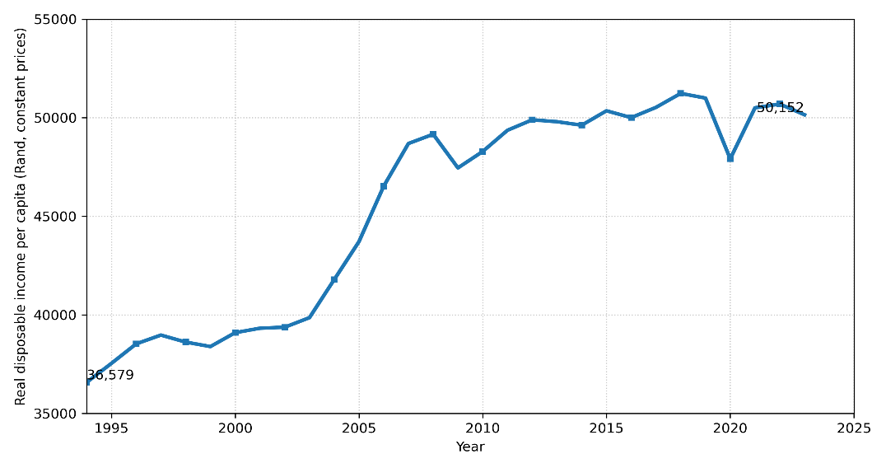
Figure 4: Real disposable income per capita (constant prices), South Africa
(Source: CRA, 2024)
This helps explain an important feature of South Africa’s recent economic experience: household consumption has persisted, but without generating sustained growth acceleration. Consumption has often been maintained through income smoothing, credit or transfers, rather than through rising real incomes.
Such dynamics can stabilise demand in the short term, but they do not substitute for a growth model rooted in expanding productive capacity.
GROWTH THAT FEELS WORSE THAN IT LOOKS
At this point, a tension emerges.
On the one hand, South Africa’s economy continues to function. Output expands, inflation is broadly contained and the macroeconomic system remains intact. On the other hand, lived experience is characterised by stagnation, insecurity and declining confidence in the future.
This tension is not primarily psychological, nor is it the result of misinformation. It reflects the reality of an economy in which aggregate growth is persistently diluted at the per-capita level, and where modest gains are insufficient to absorb new entrants into the labour market or expand fiscal space meaningfully.
Importantly, this experience is not unique to South Africa. Many middle-income economies that fail to accelerate growth encounter similar dynamics. What remains to be examined, however, is whether South Africa’s performance is unusually weak in comparative terms or whether it sits broadly within the range observed among its peers.
That question is the focus of the next section.
PART II
SOUTH AFRICA IN COMPARATIVE PERSPECTIVE
WHY COMPARATIVE CONTEXT MATTERS
Economic performance cannot be assessed in isolation. Growth rates, investment levels, inflation and fiscal outcomes are all shaped by structural characteristics that economies share at similar levels of development. Without comparison, it becomes difficult to distinguish between what is unusual and what is typical.
Public debate in South Africa frequently oscillates between two extremes. On the one hand, the country is portrayed as uniquely failing, an outlier whose economic outcomes cannot be explained by reference to international experience. On the other, it is occasionally framed as broadly comparable to advanced economies, implying that growth should be both faster and easier to achieve.
Neither position withstands scrutiny. South Africa is best understood as a middle-income economy with mature features, facing constraints that are common to its peers, but compounded by domestic weaknesses.
Comparative analysis allows us to locate South Africa more precisely within this landscape.
GROWTH PERFORMANCE RELATIVE TO PEERS
When South Africa’s growth performance is compared with other upper-middle-income economies, a clear pattern emerges. Growth has been weaker than many peers, but not dramatically or exceptionally so. South Africa has not experienced the kind of prolonged contraction associated with macroeconomic collapse, nor has it achieved the sustained acceleration seen in successful growth transitions.
Instead, its performance clusters around the lower end of the middle-income range.
World Bank World Development Indicators show that GDP growth outcomes among upper-middle-income economies vary widely over time and across global cycles, but tend to cluster around modest positive rates during periods of relative stability, rather than around a single fixed benchmark (World Bank, 2024). This distinction matters. Being a modest underperformer implies a different diagnosis and a different policy conversation from being a structural outlier.

Figure 5: Real GDP growth outcomes, South Africa and selected upper-middle-income peers (2000–2023). Peer outcomes are shown for comparative context; World Bank income-group data indicate a wide distribution of growth outcomes among upper-middle-income economies, rather than a single benchmark average. Illustrative midpoint of observed upper-middle-income growth outcomes.
(Source: CRA, 2024)
INFLATION, STABILITY AND THE ABSENCE OF MACROECONOMIC BREAKDOWN
Another feature that distinguishes South Africa from genuine economic outliers is the relative stability of its macroeconomic framework. Inflation has remained broadly contained within a moderate range, even during periods of weak growth and external shocks. Interest rates have adjusted, sometimes sharply, but within a functioning monetary policy framework.
Similarly, South Africa has avoided the kinds of external imbalances that characterise economies in acute distress. While current account deficits have widened at times and the currency has depreciated over the long term, these dynamics have unfolded in a manner consistent with a small open economy exposed to global volatility, rather than one experiencing systemic collapse.
This does not imply comfort or success, because currency weakness has eroded purchasing power, raised input costs and it has fed social frustration. But it does indicate that the economy retains shock-absorbing capacity, rather than being locked into crisis dynamics.

Figure 6: Headline inflation rate (%), South Africa, 1986–2023
(Source: CRA, 2024)
INVESTMENT AND SAVINGS IN COMPARATIVE PERSPECTIVE
Weak investment and low domestic savings are among the most persistent features of South Africa’s economic performance. They are also among the most frequently cited explanations for the country’s subdued growth trajectory. Yet these outcomes are often discussed in isolation, without sufficient reference to how similar economies have performed under comparable structural conditions.
In comparative perspective, South Africa’s experience is disappointing, but not anomalous. Many upper-middle-income economies that struggle to sustain higher growth rates exhibit a similar combination of low savings, modest capital formation and reliance on consumption and credit to support demand. What distinguishes faster-growing peers is not the absence of constraint, but the ability to mobilise higher levels of investment relative to income, either through stronger domestic savings, sustained public capital expenditure or successful attraction of long-term foreign investment.
South Africa’s savings rate has remained persistently low, which limits the economy’s capacity to finance investment internally and increases reliance on external capital flows, which are inherently volatile and tend to favour short-term portfolio investment over long-horizon productive capital. The result of these dynamics is an investment profile that is episodic, being one that is sustained and defensive, rather than expansionary.
Investment outcomes must also be understood in relation to the broader financing environment within which firms operate and so, while structural and policy factors clearly matter, investment decisions are made in a context shaped by the cost of capital, access to finance and macroeconomic conditions. These factors influence not only whether firms invest, but the scale, timing and nature of that investment.
The figure below therefore situates South Africa’s investment performance within its long-run interest-rate environment, using the repo rate as a proxy for the underlying price of capital set by monetary policy. This does not imply that interest rates are the primary cause of weak investment. Rather, it provides context for assessing whether South Africa’s investment shortfall can plausibly be explained by an unusually restrictive financing environment or whether deeper structural constraints are at play.
The evidence suggests the latter. Investment has remained weak across periods of both relatively high and relatively low interest rates, which seems to indicate that capital formation in South Africa is constrained not so much by short-term financing conditions and more by structural factors affecting confidence, expected returns and productive opportunity.

Figure 7: Repo rate (%), South Africa, 1986–2023
(Source: CRA, 2024)
CONSUMPTION-LED STRUCTURES AND GROWTH LIMITS
South Africa’s economic structure is characterised by relatively high levels of consumption and comparatively low levels of investment. This configuration is not unique among middle-income economies, but it does impose clear limits on growth potential.
Consumption can support demand in the short term, particularly when public transfers or credit expansion play a stabilising role. However, consumption-led growth without corresponding investment expansion tends to exhaust itself and it does not generate the productivity gains required for sustained acceleration.
Comparative data shows that economies with stronger growth trajectories typically combine consumption with robust capital formation and export expansion and therefore, South Africa’s divergence from this pattern helps explain its position as an underperformer, rather than an outlier.
NOT EXCEPTIONAL AND THAT IS PRECISELY THE POINT
The comparative evidence leads to an important and often uncomfortable, conclusion.
South Africa’s economic performance is disappointing, but not exceptionally so. Its weaknesses are real, persistent and costly, but they are also recognisable within the broader experience of middle-income economies that have struggled to transition to higher growth paths.
This conclusion challenges two common narratives simultaneously. It rejects the claim that South Africa’s economy is uniquely broken. It also rejects the assumption that the country should, by default, be expected to outperform its peers.
Expecting growth well above the middle-income norm requires identifying what makes an economy exceptional. Such exceptions usually rest on unusually high investment, rapid productivity growth, demographic dividends or successful integration into expanding global markets. In the absence of these drivers, performance tends to converge toward the mean.
At this stage, the evidence that has been presented cannot plausibly suggest that South Africa has established the conditions necessary for sustained outperformance.
THE EMERGING QUESTION
A paradox now becomes clear.
If South Africa’s macroeconomic performance is broadly consistent with, though weaker than, that of many middle-income peers, why do economic pressures feel so acute? Why does stagnation translate into such severe social and fiscal strain?
The answer does not lie solely in growth rates themselves. It lies in how growth interacts with other structural forces shaping the economy.
That interaction becomes the focus of the next section.
PART III
INVESTMENT AS THE BINDING CONSTRAINT
FROM SYMPTOMS TO CONSTRAINTS
Up to this point, the report has established three things. First, South Africa’s economy has continued to grow, but weakly. Second, per-capita outcomes have stagnated, shaping lived economic experience. Third, in comparative terms, South Africa is a modest underperformer, rather than an extreme outlier.
These observations describe what has happened. The question now is why growth has remained persistently weak.
Across economies and over time, one variable consistently distinguishes those that accelerate growth from those that stagnate: investment. Without sustained capital formation, economies struggle to expand productive capacity, raise productivity or generate durable employment growth.
In South Africa’s case, investment emerges as the central binding constraint.
LONG-TERM INVESTMENT TRENDS
Gross fixed capital formation as a share of GDP has declined steadily over time. While short-term fluctuations occur, the broader trend is unmistakable: South Africa invests less today, relative to the size of its economy, than it did in earlier periods and less than many of its peers.
This is not a technical detail. Investment determines the future growth frontier of an economy. It shapes infrastructure quality, industrial capacity, energy availability, logistics efficiency and the adoption of new technologies. When investment is persistently weak, growth outcomes follow suit.
The problem is therefore not simply cyclical hesitation or temporary uncertainty. It is a structural shortfall that has narrowed the economy’s potential growth path.

Figure 8: Gross fixed capital formation as a percentage of GDP, South Africa
(Source: CRA, 2024)
PUBLIC AND PRIVATE INVESTMENT DYNAMICS
Disaggregating investment reveals an additional layer of constraint, where both public and private investment have underperformed, though for different reasons.
Public investment has been uneven and increasingly constrained by fiscal pressures, where capital expenditure by government and public corporations has failed to keep pace with infrastructure needs, which deficit has resulted in material maintenance backlogs, severe capacity bottlenecks and rising costs across the economy.
Private investment, meanwhile, has been cautious and episodic, where periods of optimism have not translated into sustained capital deepening and instead, investment decisions have tended to favour balance-sheet protection, offshore diversification or short-term returns rather than long-horizon productive expansion.
The combined effect has been a low-investment equilibrium, in which neither the public nor the private sector acts as a consistent growth catalyst.

Figure 9: Public and private investment, South Africa (1970–2023)
(Source: CRA (2024))
INFRASTRUCTURE BACKLOGS AS AN ECONOMIC CONSTRAINT
The consequences of under-investment are most visible in the accumulation of infrastructure backlogs across key economic sectors, which is the result of years of deferred maintenance, of delayed expansion and of uneven capital spending, all of which have eroded the reliability and capacity of the economic infrastructure that is needed to underpin economic activity. These backlogs are not merely technical shortcomings. They operate as binding constraints on growth by raising costs, increasing uncertainty and reducing the effective productivity of both labour and capital.
In the energy sector, insufficient and delayed investment in generation, transmission and maintenance has translated into supply instability and rising operating costs across the economy, which has forced firms to invest in self-generation or backup capacity, resulting in a diversion of capital away from productive expansion, not to mention the reinforcing of the barriers to entry for smaller enterprises. And even where energy availability has improved at the margin, the legacy of the under-investment in electricity generation continues to weigh on confidence and long-term planning.
Logistics and transport infrastructure exhibit similar dynamics, where inadequate maintenance and expansion of ports, rail networks and freight corridors, for example, increasing turnaround times, reducing reliability and raising input and export costs.
These constraints weaken South Africa’s ability to compete in regional and global markets and they limit the economy’s capacity to benefit from commodity cycles or export-led growth opportunities, with the result being not an absence of demand, but an inability to translate demand into sustained output growth.
Municipal and urban infrastructure backlogs further compound these pressures, in that aging water systems, sanitation networks and local road infrastructure raise operating costs for firms and households alike, whilst simultaneously also undermining service reliability and investment attractiveness at the local level. It should be mentioned that these deficiencies disproportionately affect lower-income communities and secondary cities, thereby reinforcing the spatial inequality and constraining the diffusion of economic activity beyond established economic hubs.
Taken together, infrastructure backlogs help explain why periods of cyclical recovery have failed to translate into durable growth acceleration, because even when the macroeconomic conditions stabilise and demand recovers, supply-side constraints limit the economy’s ability to respond. In this context, weak investment is not simply a missed opportunity; it actively narrows the range of feasible growth outcomes.
THE CONSEQUENCES OF UNDER-INVESTMENT
The consequences of weak investment extend well beyond GDP growth rates.
Firstly, limited capital formation constrains productivity gains, because new machinery, technology and infrastructure is needed to improve productivity. The current low level of investment has resulted in productivity that can at best be described as incremental, rather than transformative.
Secondly, low investment weakens labour absorption, because even where output expands modestly, the economy without sufficient investment will struggle to create adequate employment opportunities, particularly for new entrants.
Thirdly, fiscal pressure intensifies, in that weak growth limits revenue expansion, while infrastructure deficits raise future costs, which then creates a feedback loop in which fiscal consolidation further constrains public investment capacity.
None of these dynamics is unique to South Africa; they are common features of middle-income economies that are caught in prolonged low-investment traps.
SAVINGS, FINANCING AND STRUCTURAL LIMITS
Domestic savings play a critical role in sustaining investment and in this respect, South Africa’s savings rates have remained low relative to GDP, thereby limiting the economy’s capacity to finance investment internally.
Low savings increase dependence on external capital flows, which are inherently volatile and which, in turn, constrains policy space and amplifies sensitivity to global financial conditions. Moreover, it discourages long-term investment planning, which then reinforces short-termism in both public and private decision-making.
Comparative evidence suggests that economies which successfully accelerate growth, typically combine higher investment with stronger domestic savings mobilisation, the divergence from which in South Africa pattern further explains the persistence of weak growth.

Figure 10: Gross domestic saving (% of GDP), South Africa, 1970–2023
(Source: CRA, 2024)
WHY INVESTMENT MATTERS MORE THAN ANY OTHER VARIABLE
Investment occupies a unique position in the growth process. Unlike consumption, it expands future productive capacity and unlike transfers, it raises potential output. Unlike temporary stimulus, it compounds over time.
This is why investment shortfalls cannot be offset indefinitely by demand-side measures, because consumption-led growth without investment ultimately runs into structural limits, which produces the very stagnation South Africa now experiences.
The persistence of weak investment therefore provides the most parsimonious explanation for South Africa’s modest growth performance relative to peers. It also explains why recovery phases have failed to translate into sustained momentum.
A CONSTRAINT, NOT A VERDICT
Identifying investment as the binding constraint is not a declaration of inevitability, but instead, it is an analytical observation that is grounded in evidence.
Growth acceleration from a middle-income base has occurred elsewhere, but it has done so where investment rose sharply, productivity improved and export capacity expanded. Absent such shifts, economies tend to remain within narrow growth bands.
At this point, South Africa’s experience conforms to this pattern.
Yet a question still remains unresolved. If South Africa’s growth underperformance is broadly consistent with its investment profile and comparable to many middle-income peers, why does economic pressure feel disproportionately severe?
Answering that question requires turning to a factor that shapes how growth, or the absence of it, is experienced across society.
That factor is population.
PART IV
MACROECONOMIC STABILITY AND ITS LIMITS
STABILITY WITHOUT MOMENTUM
A striking feature of South Africa’s recent economic experience is the coexistence of weak growth with relative macroeconomic stability. This combination often confuses public debate. Stability is sometimes misread as success and weak growth, in turn, is sometimes assumed to signal impending crisis.
Neither inference is correct.
South Africa’s macroeconomic framework has remained intact through a period of prolonged strain. Inflation has been contained within moderate ranges for most of the past decade. Monetary policy has operated consistently. Fiscal stress has intensified, but without triggering loss of market access or uncontrolled financing dynamics.
This stability matters. It distinguishes South Africa from economies experiencing genuine macroeconomic breakdown. But it does not, on its own, generate growth.
THE EXTERNAL SECTOR: CONSTRAINT AND CUSHION
South Africa’s position as a small open economy exposes it to global volatility. Commodity cycles, capital flows and shifts in global demand all shape domestic outcomes and over time, the external sector has acted as both a constraint and a cushion.
Exports remain concentrated in a relatively narrow range of commodities and manufactured goods, which limits diversification and exposure to fast-growing global value chains, but that said, export earnings have at the same time provided a buffer during periods of global commodity strength by partially offsetting domestic weaknesses.
The current account has oscillated between deficit and surplus, reflecting shifts in trade balances, income flows and global conditions, which movements are consistent with those observed in many middle-income economies and do not, in themselves, indicate structural imbalance.

Figure 11: Current account balance (% of GDP), South Africa, 1960–2023
(Source: CRA, 2024)
What they do indicate is an economy operating close to its external constraint, able to adjust, but not easily able to expand without triggering renewed pressure.
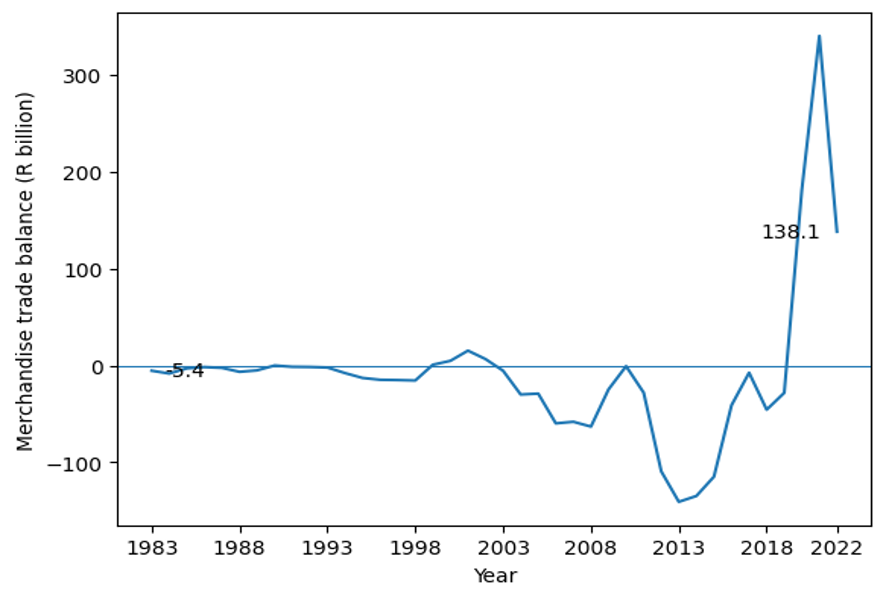
Figure 12: Merchandise trade balance (R billion), South Africa, 1983–2022
(Source: CRA, 2024)
THE EXCHANGE RATE: ADJUSTMENT, NOT COLLAPSE
The long-term depreciation of the rand is often cited as evidence of economic failure, but in practice, it reflects a more complex interaction of structural factors, because as a flexible currency in an open financial system, the rand has managed to absorb external shocks that might otherwise have manifested through sharper output or employment adjustments. Depreciation has supported export competitiveness at the margin and acted as a pressure valve during periods of global stress.
At the same time, currency weakness imposes real costs in that it raises the price of imported inputs, erodes purchasing power and contributes to inflationary pressure, particularly for lower-income households, the effects of which reinforce perceptions of decline, even in the absence of macroeconomic collapse.
The key point that is being made here is that exchange rate adjustment has been a mechanism of adaptation and not a sign of imminent failure.

Figure 13: South African rand (ZAR) average daily foreign-exchange turnover (USD billions), BIS Triennial Surveys, 1995–2025
(Source: Bank for International Settlements (BIS), Triennial Central Bank Survey 2025: OTC foreign exchange market turnover in April 2025, Tables 25.1 (1995–2010) and 25.2 (2013–2025), “OTC foreign exchange turnover by currency”, net-net basis, daily averages in April (USD billions))
An often-overlooked feature of the rand is that, despite long-term depreciation, it remains one of the most actively traded emerging-market currencies globally. High foreign-exchange turnover is not a trivial metric. It signals depth, liquidity and trust in the functioning of the currency market itself. Currencies that lack credibility, convertibility or institutional backing do not trade at scale; they become illiquid, segmented or administratively constrained.
The rand’s heavy trading therefore reflects confidence not in South Africa’s growth trajectory, but in its financial architecture. Investors are willing to hold, hedge, trade and settle rand positions precisely because the currency remains fully convertible, price-driven and embedded in global financial markets. In this sense, exchange-rate weakness has occurred within a functioning market, rather than through market breakdown. Depreciation has been the mechanism of adjustment, not a symptom of systemic failure.
DEMAND SUPPORT AND ITS LIMITS
In response to weak growth, South Africa has relied heavily on demand support, through household consumption, social transfers and, at times, accommodative financial conditions, which measures have played an important stabilising role, preventing deeper contraction during downturns.
However, despite the country’s reliance on demand support, it has not translated into sustained acceleration. Consumption has remained relatively high as a share of GDP, but without the investment expansion required to lift productive capacity and as a result, demand-led growth impulses have tended to dissipate, rather than compound.
This pattern is common among middle-income economies where structural constraints limit supply-side response. Without sufficient investment and productivity gains, demand stimulus can stabilise the economy, but it cannot transform it.

Figure 14: Demand support and its limits — real consumption versus real investment, South Africa (1994–2023)
(Source: CRA (2024))
WHY STABILITY IS NOT ENOUGH
Macroeconomic stability is a necessary condition for growth, but it is not a sufficient one. An economy can remain stable while stagnating and this is precisely the condition South Africa has experienced.
Stable inflation does not guarantee rising incomes. A functioning currency does not ensure expanding opportunity. Avoiding crisis is not the same as achieving progress.
Recognising this distinction is crucial, since it allows us to acknowledge what has held while remaining clear-eyed about what has not improved.
THE QUESTION REVISITED
By this point in the analysis, the contours of South Africa’s economic experience are clear.
Growth has been weak but positive
Per-capita outcomes have stagnated
Investment has been persistently low
Macroeconomic stability has been maintained
Comparative performance is disappointing, but not exceptional
And yet, economic pressure feels acute, fiscal space constrained and social stress intense.
If the economy is not uniquely unstable and if growth weakness is broadly consistent with its investment profile and income level, what explains the severity of the experience?
The answer lies not in macroeconomic failure alone, but in how growth interacts with another powerful force shaping outcomes.
That force is population.
PART V
POPULATION GROWTH AND THE PER-CAPITA SQUEEZE
RETURNING TO THE CENTRAL PUZZLE
By this stage, the evidence has narrowed the field of plausible explanations.
South Africa’s economy is not in macroeconomic collapse. Its growth performance, while weak, is broadly consistent with that of a middle-income economy facing low investment and structural constraints.
Inflation is contained, external balances adjust and institutions continue to function.
Yet the pressure experienced by households, the fiscal system and the labour market is intense. Public frustration is deep and persistent. The gap between economic performance and social experience appears unusually wide.
This section addresses that gap.
POPULATION GROWTH AS A CONDITIONING VARIABLE
Population growth is often treated as a background demographic fact, rather than an active economic variable. In reality, it conditions how economic performance is experienced and how growth outcomes translate into lived reality.
South Africa’s population has continued to grow at a pace that is high relative to many upper-middle-income economies. While exact rates vary over time, the overall trend has been one of sustained demographic expansion.
On its own, population growth is neither good nor bad. In rapidly growing economies with high investment and strong labour absorption, it can support expansion. In economies with weak growth and limited investment, however, population growth dilutes per-capita gains and intensifies pressure on institutions, infrastructure and labour markets.
THE ARITHMETIC OF PER-CAPITA DILUTION
The implications of population growth are not ideological; they are arithmetical.
When economic growth barely exceeds population growth, the result is stagnation in GDP per capita. When growth falls below population growth, per-capita incomes decline. Even modest population increases can therefore materially worsen lived outcomes when growth is weak.
This helps explain why aggregate GDP growth, however limited, has failed to translate into broad improvement. Output has expanded slowly, but it has had to be shared across a growing population. The result is heightened competition for employment, constrained fiscal space and rising demand for public services without commensurate revenue growth.
Population growth does not explain why the economy grows slowly. It explains why slow growth feels harsher.

Figure 15: Real GDP growth versus real GDP per-capita growth, South Africa (1994–2023)
(Source: CRA (2024). Real GDP growth from LG real economic growth 61–2026; real GDP per-capita growth calculated as the year-on-year percentage change in the LG GDP & disposable income per capita series)
SOUTH AFRICA IN COMPARATIVE DEMOGRAPHIC PERSPECTIVE
South Africa’s economic performance is often assessed in aggregate terms, with headline indicators such as GDP growth, employment creation or fiscal balances dominating public and policy debate. While these measures are important, they can obscure a critical underlying dynamic: the scale and pace of population growth relative to that of peer economies. Demography does not determine economic outcomes in a mechanical sense, but it does shape the context within which growth must occur, particularly when assessing per-capita living standards.
In comparative perspective, South Africa’s population growth rate has been persistently higher than that of many upper-middle-income and emerging-market peers. While several comparator economies entered demographic transition earlier and now experience relatively modest population expansion, South Africa has continued to record population growth well in excess of one per cent per annum for much of the post-1994 period. This has materially raised the threshold of economic growth required to merely stabilise per-capita income, let alone achieve sustained improvements in living standards over time.
The implication is straightforward, but often underappreciated, but to be clear when population growth is rapid, a given rate of aggregate economic expansion translates into smaller gains at the individual level. Even where total output increases, the benefits are spread across a larger population base, diluting the impact on per-capita income and as a result, economic performance that appears moderate or even respectable in aggregate terms may still feel inadequate from the perspective of households and workers.
To illustrate the significance of this demographic effect, a counterfactual benchmark can be introduced. Rather than assuming an unrealistically low or static population, the analysis applies a peer-norm population growth rate of 0.8 per cent per annum, broadly consistent with the demographic experience of upper-middle-income economies over the past three decades. Importantly, this benchmark is not presented as an observed outcome, but as an analytical device designed to isolate the effect of population growth on per-capita outcomes.
Holding South Africa’s actual real GDP trajectory constant and applying this alternative population path allows for a direct comparison between observed per-capita income outcomes and those that would have prevailed under more moderate demographic expansion. The resulting divergence is not a reflection of different growth policies, investment strategies or external conditions; it arises solely from differences in population dynamics and so in this sense, the comparison helps reframe debates about economic underperformance by distinguishing between absolute failure and relative pressure imposed by demography.
Seen in this light, South Africa’s challenge is not simply one of insufficient growth, but of growth occurring in a context of unusually strong population expansion for an economy at its level of development. Recognising this does not diminish the need for faster, more inclusive growth, instead it sharpens the diagnosis by clarifying why even periods of positive economic performance have struggled to translate into meaningful improvements in per-capita income and lived economic experience.

Figure 16: Real GDP per capita under actual and counterfactual population growth paths, South Africa (1994–2023)
(Source: CRA, 2024)
THE COUNTERFACTUAL: WHY POPULATION CHANGES THE INTERPRETATION
To illustrate the effect of population dynamics, it is useful to consider a counterfactual scenario.
If South Africa’s population growth had been closer to that typically observed among upper-middle-income peers, around 0.8 per cent per year, consistent with demographic patterns observed among upper-middle-income economies, the same aggregate growth performance would have produced materially different per-capita outcomes. Income stagnation would have been less pronounced. Fiscal pressure would have eased marginally. Labour market absorption would still have been insufficient, but the scale of stress would have been reduced.
Under such conditions, South Africa’s economic performance would likely be classified not as near-failure, but as modest underperformance within a recognisable middle-income pattern.
This counterfactual does not absolve policy failures. It clarifies interpretation.
WHAT POPULATION DOES AND DOES NOT EXPLAIN
Population growth does not explain weak investment, infrastructure failures, governance breakdowns or low productivity. These remain central constraints on South Africa’s growth trajectory.
What population growth explains is the intensity of the consequences. It amplifies the impact of weak growth, low investment and limited labour absorption. It turns underperformance into crisis-like experience at the household and fiscal level.
In this sense, population growth acts as a multiplier of stress, not as its root cause.
WHY THIS MATTERS FOR THE GROWTH DEBATE
Recognising the role of population dynamics reframes the national growth debate in important ways.
Firstly, it exposes the limits of slogan-based growth targets, because calls for rapid growth gains often ignore the base effect and the scale of demographic pressure. Growth above the middle-income norm is not impossible, but it requires clearly articulated drivers capable of outrunning population expansion.
Second, it sharpens the diagnosis. The challenge South Africa faces is not simply to grow faster, but to grow fast enough, consistently, to generate rising per-capita outcomes in a context of sustained demographic pressure.
Finally, it clarifies what is at stake. Without higher investment, productivity gains and export expansion, demographic pressure will continue to magnify economic weakness, regardless of macro stability.
THE ARGUMENT REASSEMBLED
Viewed together, the evidence now forms a coherent whole.
South Africa’s economy is not collapsing, but it is not converging toward higher prosperity either. Growth has been persistently weak, investment insufficient and per-capita gains elusive. In comparative terms, this places the country among modest underperformers, rather than exceptional failures.
Population growth does not explain this underperformance. It explains why its consequences are felt so severely.
This distinction matters. It shifts the conversation away from moral judgement and toward structural reality. It does not lower ambition. It clarifies the scale of the task.
What remains is to draw together what the evidence allows us to say and, equally importantly, what it does not.
That is the purpose of the concluding section
CONCLUSION
TAKING STOCK OF THE EVIDENCE
This report set out to answer a narrow, but consequential question: how has South Africa’s economy actually performed and how should that performance be interpreted?
The evidence points to a clear, if uncomfortable, conclusion. South Africa’s economy has not collapsed, nor has it achieved sustained progress. Growth has been persistently weak, investment insufficient and per-capita gains elusive. Macroeconomic stability has been preserved, but without translating into rising living standards.
These outcomes are neither mysterious, nor uniquely South African. They reflect a recognisable middle-income growth pattern shaped by structural constraints, low capital formation and limited productivity gains.
FROM DIAGNOSIS TO CONDITIONS FOR RELIEF
Taken together, the evidence points to a narrow, but powerful implication. South Africa’s economic strain is not the product of a single failure, but of the interaction between persistently weak growth and sustained demographic pressure. Relieving that strain therefore requires movement on both fronts simultaneously. A lower population growth trajectory over the coming decade would reduce the dilution of per-capita gains, while sustained GDP growth in the region of four per cent would materially expand economic capacity. Either shift on its own would ease pressure. In combination, they would alter the arithmetic that currently defines lived economic experience.
Importantly, neither of these shifts implies coercive intervention or exceptional performance. Population growth typically moderates as countries urbanise, expand access to education, particularly for women, improve primary healthcare and reproductive health services, and reduce economic insecurity at the household level.
These are features of development, rather than instruments of control. South Africa’s demographic trajectory is therefore not immutable. Over time, policies that raise educational attainment, improve health outcomes and strengthen household resilience are likely to yield a slower population growth path, more closely aligned with patterns observed in other upper-middle-income economies.
At the same time, the evidence presented in this report makes clear that growth outcomes in the region of four per cent are not achieved through demand support alone. Such outcomes are typically associated with a sustained rise in investment, improved productivity and the removal of binding constraints on economic expansion.
In South Africa’s case, these constraints are well known: inadequate and unreliable infrastructure, particularly in energy and logistics, low and volatile private investment driven by policy uncertainty and weak confidence, limited public capital formation due to fiscal pressure and an economic structure that has struggled to translate stability into expansion.
Addressing these constraints does not require a departure from macroeconomic prudence, nor does it imply the pursuit of unattainable growth targets. Rather, it requires restoring the conditions under which investment becomes durable, rather than episodic. This includes credible and predictable policy frameworks, the effective maintenance and expansion of core economic infrastructure and institutional capacity sufficient to execute investment at scale. Without such shifts, growth is likely to remain trapped within narrow bands, regardless of short-term stimulus or cyclical recovery.
The interaction between these two dimensions is decisive. Lower population growth reduces the growth threshold required to achieve rising per-capita outcomes. Higher and more sustained investment-led growth raises the economy’s capacity to absorb labour, expand incomes and generate fiscal space. When pursued together, these dynamics reinforce one another. When pursued in isolation, their effects are partial and easily overwhelmed.
This is the central implication of the evidence. South Africa’s challenge is not that prosperity is unattainable, nor that decline is inevitable. It is that modest underperformance, when combined with sustained demographic pressure, produces outcomes that feel intolerable at the household and institutional level. Shifting either growth or population dynamics would help. Shifting both would fundamentally change the country’s medium-term trajectory.
WHAT WOULD CHANGE THE PER-CAPITA ARITHMETIC?
The evidence presented in this report points to a narrow set of conditions under which South Africa’s economic experience would begin to change materially. These conditions do not constitute a policy programme, nor do they guarantee success. They define an envelope of feasibility within which sustained improvement becomes possible.
1. A lower population growth trajectory
South Africa’s current demographic dynamics amplify the effects of weak growth by diluting per-capita gains. Over time, population growth typically moderates as countries urbanise, expand access to education (particularly for women), improve primary healthcare and reproductive health services, and reduce household economic insecurity. A gradual shift toward a population growth rate closer to that observed in many upper-middle-income economies, in the region of 0.8 per cent per year, would materially ease per-capita pressure without requiring coercive intervention.
2. Sustained growth of around four per cent
Growth outcomes in the region of four per cent are not exceptional by international standards, but they do require conditions that South Africa has struggled to sustain. Such growth is typically associated with higher and more stable investment, improved productivity and the removal of binding constraints, particularly in energy, logistics and infrastructure. Without addressing these constraints, growth is likely to remain trapped in narrow bands regardless of short-term recovery or demand support.
3. Why the combination matters
Either of these shifts on its own would help. Lower population growth reduces the threshold at which growth translates into rising per-capita outcomes. Higher growth expands economic capacity and fiscal space. Pursued together, they reinforce one another. Pursued in isolation, their effects are partial and easily overwhelmed.
4. What this does not imply
This framing does not suggest that South Africa’s challenges would be fully resolved within a decade, nor does it downplay deep structural problems in the labour market, spatial economy or governance. It does not imply that growth targets are automatic or that demographic change is a short-term lever. It clarifies, instead, the conditions under which the economy would begin to shift from chronic per-capita strain toward gradual improvement. |
WHAT THE EVIDENCE SUPPORTS
Based on the data and comparative analysis, several claims are well supported.
South Africa is best described as a modest underperformer among middle-income economies, rather than as an extreme outlier. Its growth rates have fallen below those of many peers, but not by margins that suggest systemic economic breakdown.
Investment emerges as the central binding constraint on growth. Without sustained capital formation, public and private, the economy’s capacity to expand remains limited and productivity gains incremental.
Population growth materially worsens per-capita outcomes. It does not cause weak growth, but it amplifies its consequences, intensifying pressure on households, public services and the fiscal system.
Finally, macroeconomic stability has functioned as a stabiliser, rather than a catalyst. It has prevented crisis, but it has not delivered convergence.
WHAT THE EVIDENCE DOES NOT SUPPORT
The evidence does not support claims that South Africa’s economy is uniquely broken or on the verge of collapse. Nor does it support the assumption that high growth should be automatic or easily achievable.
Calls for sustained growth well above middle-income norms require explanation. Exceptional outcomes demand exceptional drivers. At present, such drivers, in the form of unusually high investment, rapid productivity gains or large-scale export expansion, are not evident at sufficient scale.
Equally, the evidence does not support complacency. Weak growth compounded by demographic pressure is not a stable equilibrium. Without change, per-capita stagnation will persist and social stress will deepen.
REFRAMING THE NATIONAL ECONOMIC DEBATE
The value of evidence lies not in providing comfort, but in clarifying choices.
Recognising that South Africa’s performance is not exceptional, does not lower ambition. It shifts the debate from slogans to feasibility. It forces a more serious conversation about what would be required to alter the growth path and what trade-offs such a shift would entail.
Growth above the middle-income norm is possible, but not accidental. It depends on investment, productivity and structural transformation. Without these, expectations of rapid acceleration amount to aspiration, rather than analysis.
A FINAL OBSERVATION
South Africa’s economic challenge is not best understood as failure in isolation. It is better understood as insufficient growth in the face of sustained demographic pressure.
That distinction matters. It does not absolve policy shortcomings. It does not deny hardship. It does, however, provide a clearer starting point for serious engagement.
Evidence does not dictate solutions. It defines the terrain on which solutions must be found.
REFERENCES
Bank for International Settlements (BIS). 2025. Triennial Central Bank Survey: OTC foreign exchange market turnover in April 2025. Basel: Bank for International Settlements. Tables 25.1 (1995–2010) and 25.2 (2013–2025), “OTC foreign exchange turnover by currency”, net-net basis, average daily turnover in April (USD billions). [Online] Available at: https://www.bis.org/statistics/rpfx25_fx_annex.pdf [accessed 10 February 2026].
Centre for Risk Analysis (CRA). 2024. Socio Economic Survey. The Economy. [Online] Available at: https://cra-sa.com/products/socio-economic-survey/2025 [accessed: 10 February 2026]
Centre for Risk Analysis (CRA). 2024. Socio Economic Survey. Employment. [Online] Available at: https://cra-sa.com/products/socio-economic-survey/2025/files/employment-december-2024.pdf [accessed: 10 February 2026]
Centre for Risk Analysis (CRA). 2024. Socio Economic Survey. Demographics. [Online] Available at: https://cra-sa.com/products/socio-economic-survey/2025/files/demographics-january-2025-02.pdf [accessed: 10 February 2026]
Mohr, P., 2016. Economic Indicators. 5th ed. Pretoria: Van Schaik Publishers.
Statistics South Africa (Stats SA). 2025. Statistical Release P0441 Gross domestic product. Third quarter 2025. [Online] Available at: https://www.statssa.gov.za/publications/P0441/P04413rdQuarter2025.pdf [accessed: 10 February 2026]
Statistics South Africa (Stats SA). 2025. Statistical Release P0211 Quarterly Labour Force Survey Quarter 3: 2025 [Online] Available at: https://www.statssa.gov.za/publications/P0211/P02113rdQuarter2025.pdf [accessed: 10 February 2026]
World Bank. 2024. GDP growth (annual %) – Upper middle income. World Development Indicators. Available at:https://data.worldbank.org/indicator/NY.GDP.MKTP.KD.ZG?locations=XT&utm
World Bank. (2024. Population growth (annual %), upper-middle-income group, World Development Indicators. Data accessed from https://data.worldbank.org/indicator/SP.POP.GROW?locations=XT [accessed 10 February 2026].
ANNEXURE A
DEMOGRAPHIC PRESSURE AND UNEMPLOYMENT: A STYLISED COUNTERFACTUAL
PURPOSE OF THIS ANNEXURE
This Annexure explores a simple, but often overlooked question in South Africa’s unemployment debate: how much of today’s exceptionally high unemployment rate is explained by unusually rapid population and labour-force growth, rather than by uniquely poor job creation alone?
Rather than building a complex economic model, the analysis adopts a deliberately stylised counterfactual. Its purpose is not to predict an alternative history, but to isolate and illustrate the role of demographic pressure in shaping labour-market outcomes.
THE BASIC LOGIC
Unemployment is fundamentally a ratio: it reflects the relationship between the number of people looking for work and the number of jobs available. When the labour force grows faster than employment, unemployment rises or remains stubbornly high, but when employment growth outpaces labour-force growth, unemployment begins to fall.
South Africa’s post-1994 experience has been characterised by exceptionally rapid growth in the working-age population and therefore in the labour force. This has meant that even periods of positive job creation have often been insufficient to make a visible dent in unemployment, because so many new entrants were arriving in the labour market each year.

Figure 17: Employment and available labour in South Africa, 1994–2024
(Source: CRA, 2024)
The counterfactual explored here asks a narrowly defined question:
What would South Africa’s unemployment rate look like if population growth had followed a trajectory more commonly observed among upper-middle-income countries, based on World Bank income-group data, while the actual number of jobs remained unchanged?
WHAT IS HELD CONSTANT AND WHAT IS CHANGED
To keep the exercise transparent and conservative, the analysis makes only one change.
Held constant: The actual number of employed persons. No additional jobs are assumed. There is no improvement in policy, productivity or growth performance.
Changed: The size of the working-age population and labour-force pool, which is adjusted to reflect a slower population growth path that is consistent with the demographic patterns that are commonly observed among upper-middle-income countries.
In other words, the economy is treated exactly as it was. The only difference is that fewer people are competing for the same number of jobs.
This approach avoids the need for assumptions about growth elasticities, Okun-type relationships or behavioural responses and ensures that any difference in unemployment arises purely from demographic arithmetic.
HEADLINE FINDING
Under this stylised demographic counterfactual, South Africa’s expanded unemployment rate would have been materially lower than observed.
In the most recent year examined, the analysis suggests that the actual expanded unemployment rate of roughly 43 per cent would instead have been closer to the mid-30 per cent range, and the difference attributable to demographic pressure is on the order of seven to eight percentage points.
This is not a marginal effect. It is large enough to meaningfully alter how South Africa’s labour-market performance is interpreted, particularly in comparison with peer economies.
INTERPRETATION
This finding does not imply that unemployment in South Africa is “only” a demographic problem. Structural constraints, weak growth, spatial mismatch, skills barriers and policy choices remain central to the country’s labour-market crisis.
What the exercise demonstrates is something more specific: rapid population growth has significantly raised the hurdle that employment growth must clear before unemployment can begin to fall.
In a context where the labour force is expanding very quickly, even solid job creation can appear inadequate. By contrast, under a demographic trajectory more typical of upper-middle-income economies, the same level of employment would be shared among fewer work-seekers, resulting in a lower unemployment rate.

Figure 18: Employment growth and expanded unemployment, South Africa (1994–2024)
(Source: CRA, 2024)
IMPLICATIONS FOR GROWTH AND POLICY DEBATE
The demographic effect also has important implications for debates about “how much growth is needed” to reduce unemployment.
Under a lower labour-force growth scenario, moderate and sustained economic growth in the range of three to four per cent could plausibly begin to chip away at unemployment, as employment growth would more readily outpace new labour-market entrants.
Under South Africa’s actual demographic conditions, by contrast, substantially higher growth rates of five per cent or more, are likely required before unemployment begins to decline on a sustained basis.
This matters because growth outcomes in the three to four per cent range have occurred episodically among upper-middle-income economies during favourable periods, according to World Bank income-group data (World Bank, 2024), whereas sustained growth above five per cent has been comparatively rare.
WHY THIS ESTIMATE IS CONSERVATIVE
The counterfactual presented here likely understates, rather than overstates, the full demographic effect.
The analysis does not assume improved productivity or capital deepening associated with lower population pressure, reduced congestion in infrastructure and public services, higher fiscal space per capita or any positive behavioural response in labour-force participation or investment.
By holding employment fixed, the exercise deliberately strips out these potential channels. The resulting estimate should therefore be understood as a floor, not a ceiling, on the contribution of demographic dynamics to unemployment outcomes.
CONCLUDING REMARKS
This Annexure does not seek to absolve policy failure or downplay the severity of South Africa’s unemployment crisis. Instead, it highlights a structural reality that is often ignored in public debate.
South Africa has been attempting to solve an unemployment problem under demographic conditions that are considerably more demanding than those faced by many of its peers. Recognising this does not reduce the urgency of reform, but it does provide a more balanced and realistic framework for assessing performance, setting expectations and comparing outcomes across countries.
Ignoring demographic pressure risks overstating failure, whereas acknowledging it allows for a more honest diagnosis of both the scale of the challenge and the conditions under which progress becomes feasible.

Figure 19: Impact of slower population growth on SA’s expanded unemployment rate
(Source: CRA, 2024; Author, 2025)
ANNEXURE B
TECHNICAL METHODOLOGY NOTE
DEMOGRAPHIC COUNTERFACTUAL ANALYSIS OF UNEMPLOYMENT IN SOUTH AFRICA
1 OBJECTIVE OF THE TECHNICAL NOTE
This technical note documents the methodology underpinning the demographic counterfactual analysis referenced in the main report and Annexure A. It sets out, in a transparent and replicable manner, the data sources, definitions and calculation steps used to estimate the contribution of population and labour-force dynamics to South Africa’s unemployment rate.
The purpose of this exercise is analytical clarification, not forecasting. The counterfactual is intentionally stylised and is designed to isolate the arithmetic effect of demographic pressure on unemployment outcomes, holding all other factors constant.
2 CONCEPTUAL FRAMEWORK
Unemployment is defined as the relationship between the number of people seeking work and the number of jobs available. An unemployed person is someone who seeks but cannot find employment. The unemployment rate is then obtained by expressing the number of people who are willing and able to work but who do not have jobs, as a percentage of the total number of people who are willing and able to work (the labour force) (Mohr, 2016)
Formally:

Where:
UR denotes the unemployment rate,
LF the labour force, and
E the number of employed persons.
Under this identity, unemployment falls when employment grows faster than the labour force and rises when labour-force growth outpaces employment.
The counterfactual analysis exploits this identity by holding employment fixed at the actual current levels and by only altering the size of the labour-force pool via a different, that is the lower 0.8 percent, population growth trajectory.
3 DATA SOURCES AND DEFINITIONS
All variables are defined consistently with the expanded unemployment framework used by Statistics South Africa.
3.1 EMPLOYED PERSONS
Definition: Persons aged 15–64 who performed work for pay, profit or family gain during the reference period, as defined in the Quarterly Labour Force Survey (QLFS).
Source: Statistics South Africa, Quarterly Labour Force Survey (QLFS).
Treatment in the analysis: The actual observed employment levels are taken as given and are held unchanged throughout the counterfactual exercise.
3.2 EXPANDED UNEMPLOYMENT RATE
Definition: The expanded unemployment rate includes both unemployed persons actively seeking work and discouraged work-seekers.
Source: Statistics South Africa, QLFS.
Treatment in the analysis: The expanded unemployment rate is used to ensure consistency with South Africa’s labour-market realities and to avoid understating exclusion.
3.3 ECONOMICALLY ACTIVE POPULATION
Definition: The number of people that are willing and able to work but do not have jobs as a percentage of the total number of people that are willing and able to work
Source: Statistics South Africa, QLFS
Treatment in the analysis: The economically active population unemployment rate is used to ensure consistency with South Africa’s labour-market realities and to avoid understating exclusion.
3.4 WORKING-AGE POPULATION
Definition: Persons aged 15–64.
Source (actual): Statistics South Africa, Mid-Year Population Estimates.
Source (counterfactual baseline): Same series, using the earliest year in the analysis as the base year.
4 METHODOLOGICAL STEPS
Step 1: Derivation of the actual labour force
Rather than constructing the labour force from participation rates, the actual labour force is recovered directly from observed employment and unemployment using the accounting identity:

This approach ensures internal consistency between employment, unemployment and labour-force size and avoids definitional mismatches associated with alternative labour-force constructions.
Step 2: Estimation of implied participation behaviour
An implied labour-force participation rate is calculated as:

This rate reflects observed participation behaviour embedded in the data, rather than an assumed or normative participation benchmark.
Step 3: Construction of the counterfactual population path
A counterfactual working-age population series is constructed by applying a constant annual growth rate of 0.8 per cent to the baseline population.
This growth rate is broadly consistent with the demographic patterns that have been observed in upper-middle-income economies and therefore serves as a comparative benchmark, rather than being a precise demographic projection.
Step 4: Construction of the counterfactual labour force
The implied participation behaviour that is applied to the counterfactual working-age population is:

Participation behaviour is assumed to remain unchanged, which is a conservative assumption that avoids the need to introduce behavioural or policy-driven responses.
Step 5: Calculation of counterfactual unemployment
Counterfactual unemployment is calculated by holding employment fixed at its observed level:
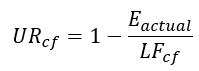
This calculation answers a narrowly defined question: what would the unemployment rate have been if the same number of jobs were shared among a smaller labour-force pool?
Step 6: Estimation of the demographic unemployment gap
The contribution of demographic pressure to unemployment is expressed as:

In the most recent year analysed, this gap is estimated at approximately 7-8 percentage points.
5 SCOPE AND LIMITATIONS
The methodology explicitly excludes the following: GDP growth modelling or forecasting, employment elasticities or Okun-type relationships, productivity or capital-deepening effects, migration adjustments, behavioural changes in participation and policy or institutional reform effects
As a result, the estimated demographic effect should be interpreted as a lower-bound, arithmetic estimate, rather than a comprehensive general-equilibrium outcome.
6 INTERPRETATION
The counterfactual does not suggest that unemployment in South Africa is solely a demographic phenomenon, nor does it minimise the role of structural constraints or policy choices. Instead, it demonstrates that unusually rapid population and labour-force growth has materially raised the threshold at which employment growth begins to reduce unemployment.
By isolating demographic pressure, the analysis provides a clearer basis for comparing South Africa’s labour-market outcomes with those of peer economies and for assessing the realism of growth expectations.
7 REPLICABILITY
All inputs used in this analysis are drawn from publicly available data published by Statistics South Africa. The calculations rely exclusively on accounting identities and can be replicated using standard spreadsheet software.
No proprietary data, econometric estimation or unpublished assumptions are employed.
- - - - - - - - - - - - - - - - - - - - - - - - - - - - - - - - -

This report has been published by the Inclusive Society Institute
The Inclusive Society Institute (ISI) is an autonomous and independent institution that functions independently from any other entity. It is founded for the purpose of supporting and further deepening multi-party democracy. The ISI’s work is motivated by its desire to achieve non-racialism, non-sexism, social justice and cohesion, economic development and equality in South Africa, through a value system that embodies the social and national democratic principles associated with a developmental state. It recognises that a well-functioning democracy requires well-functioning political formations that are suitably equipped and capacitated. It further acknowledges that South Africa is inextricably linked to the ever transforming and interdependent global world, which necessitates international and multilateral cooperation. As such, the ISI also seeks to achieve its ideals at a global level through cooperation with like-minded parties and organs of civil society who share its basic values. In South Africa, ISI’s ideological positioning is aligned with that of the current ruling party and others in broader society with similar ideals.
Email: info@inclusivesociety.org.za
Phone: +27 (0) 21 201 1589


Nano Banana 2를 써봤어요. 텍스트 설명으로 이미지를 생성하는데 업데이트 버전은 반응이 더 빠르고 출력 품질도 눈에 띄게 좋아졌어요. 실사 같은 것부터 일러스트까지 다양한 스타일을 잘 처리해요.
Cookie Clicker combines humor, strategy, and incremental gameplay to create one of the most popular idle games ever made.
For a practical sense of how open editing and topic indexing come together, a live example is often more useful than a description.
Mình không có thói quen chơi quá lâu, thường chỉ lúc rảnh mới vào xem vài game để thư giãn. Gần đây mình thử qua v79, ban đầu chỉ định lướt xem giao diện nhưng thấy các mục được sắp xếp khá rõ nên cũng chơi thử vài ván. Tốc độ tải ổn, lúc chuyển từ game này sang game khác không phải chờ lâu. Mình thích kiểu bố trí đơn giản như vậy vì không cần mất thời gian tìm kiếm. Nhìn chung trải nghiệm khá nhẹ nhàng, hợp với mình khi chỉ muốn vào chơi nhanh một lúc rồi nghỉ.
Clear and engaging post that was easy to follow throughout. I tried Online Slope Game and liked how the challenge changes as you move ahead. The ball does not wait, so quick choices matter. Better control can help players handle tight paths and reach more difficult areas.