


#9/26 Six Months Of War With Iran: What Has Happened? What Comes Next?
Read the full paper by downloading the PDF below.

PUBLICATION INFORMATION
Title: Six Months of War with Iran: What Has Happened? What Comes Next?
Rapporteur: Klaus Kotzé
Publication type: GSPN Open Consultation Mondays event report
Publication date: September 2026
Event date: 14 September 2026
This report summarises the principal discussions and conclusions arising from the event.
PUBLISHER
Global South Perspectives Network (GSPN) c/o Inclusive Society Institute (Secretariat)
5 High Cape House, 21 Ben Avenue, Vredehoek, Cape Town, 8001, South Africa
PO Box 12609, Mill Street, Cape Town, 8010, South Africa
Tel: +27 (0)21 201 1589
Website: www.globalsouthperspectives.org
COPYRIGHT
Copyright © 2026 Global South Perspectives Network. All rights reserved. Reproduction requires the publisher’s prior written permission, except for brief quotations used for review, research or scholarly citation.
SUGGESTED CITATION
Kotzé, K. 2026. Six Months of War with Iran: What Has Happened? What Comes Next? Cape Town: Global South Perspectives Network.
USE OF ARTIFICIAL INTELLIGENCE
Artificial intelligence tools may have assisted with the drafting, editing and presentation of this report. All substantive content was subject to human review. Responsibility for the final publication rests with the rapporteur and publisher.
DISCLAIMER
This report summarises contributions made during a GSPN Open Consultation Mondays event. The views expressed are those of the respective speakers and participants and do not necessarily represent those of GSPN, the Inclusive Society Institute or their affiliated organisations.
While reasonable care has been taken to ensure accuracy, no warranty is given regarding the completeness, accuracy or continued relevance of the information. This publication does not constitute professional advice. Neither GSPN nor the authors accept liability for loss or damage arising from reliance on its contents.
References to third-party organisations, products, services or websites do not constitute endorsement. GSPNtute is not responsible for external website content, availability or accuracy.
CONTENTS
1 What has this war changed?
2 Two vantage points
3 A war of choice and a war of survival
4 Three miscalculations
5 The fortress that Washington removed
6 Geography returns
7 Crossing the conventional threshold
8 What force could not do
9 The costs that were not priced
10 Who would guarantee an agreement
11 Israel’s influence and the president’s decision
12 Nationalism and nuclear weapons
13 Three paths, and what each requires
14 Reflection
Cover image: AI-generated using OpenAI’s image generation tool, 23 September 2026.
LIST OF TABLES
Table 1: Three miscalculations identified in the report
Table 2: What military force could and could not achieve
Table 3: Potential external roles in a negotiated settlement
Table 4: Three possible paths from the current conflict
LIST OF FIGURES
Figure 1: Key turning points in the adversarial relationship, as framed in the report
Figure 2: Status of the three strategic objectives stated in the discussion
Figure 3: Transmission of conflict-related economic pressure beyond the region
1 WHAT HAS THIS WAR CHANGED?
The September edition of the Open Consultation Mondays was convened 199 days after the war against Iran began. On the morning of the session the Iran–Gulf meeting on the Hormuz corridor was called off before it could begin. The fighting has slowed and the institutions have spoken. Nothing has been settled. The question put to the session was accordingly narrow: after six months, what has this war achieved, and what should the rest of the world understand about it?
Two speakers introduced the discussion. Professor Mohsen Milani, of the Center for Strategic and Diplomatic Studies at the University of South Florida, who works on Iranian politics and regional security, was joined by Professor Abel Esterhuyse, of the Department of Strategic Studies at Stellenbosch University and the South African Military Academy.
2 TWO VANTAGE POINTS
Professor Milani works on Iranian politics and American foreign policy from a university in Florida; his frame is the regional order in its long duration. Professor Esterhuyse works on strategic theory at a military academy in the Western Cape; his frame is what armed force can and cannot accomplish. Different disciplines, different continents, different formations. They agreed on almost everything that mattered. That the war is existential for Iran and elective for the United States. That the American invasion of Iraq in 2003 was the turning point which shifted the regional balance in Iran’s favour. That geography has proved decisive, that operational success has not become strategic success, that collapse would bring civil war rather than stability, that Israel’s influence was real and the American president’s responsibility absolute, that China is now the consequential external actor, and that there is no military route out of this war. Professor Esterhuyse opened by saying that what he wished to argue aligned almost entirely with Professor Milani. Two analysts with no reason to align, arriving at the same reading.
3 A WAR OF CHOICE AND A WAR OF SURVIVAL
Professor Milani opened by naming the paradox at the centre of the conflict. Despite overwhelming military strength, neither the United States nor Israel has achieved its strategic goals. The original objectives were clear enough: to eliminate the threat of Iran’s nuclear programme, to disable its missile and drone capabilities, and, should the opportunity present itself, to bring about the collapse of the Islamic Republic. Six months and two wars later - one of twelve days, one of forty - none has been secured. Iran has instead acquired leverage it did not hold before: a measure of control over navigation and the flow of oil through the Strait of Hormuz.
Professor Esterhuyse sharpened the asymmetry. The war is a war of choice for the United States. For Iran it is a war of survival, and for the Iranian government an existential one. Two parties to the same war, calculating on entirely different terms.
Professor Milani made the consequence plain. From the moment the Supreme Leader and the senior leadership were killed, winning, for Iran, meant surviving. It is a low bar. It has been cleared. He added a correction to the language now in general use. The American president has called what occurred regime change. What occurred is change within the regime: the men at the top were killed, and other men hold those offices. That is the difference between removing a government and rearranging one.
4 THREE MISCALCULATIONS
Much of Professor Milani’s presentation explained how a misreading of Iran produced this outcome. Three assumptions, each defensible on its own terms, and each wrong.
The first was that Iran’s weakened regional position meant that Iran itself was weak. Iranian policy had rested for decades on the axis of resistance: aligned forces in Iraq, Hezbollah in Lebanon - in his description Iran’s most formidable military instrument - the Assad dynasty in Syria, missiles and drones to the Houthis, support to Hamas in Gaza. Before October 2023, he argued, Iran was doing extremely well. That structure has since been dismantled. Soleimani was assassinated in 2020, a case in which one individual mattered more than the institution around him; Assad had fallen, a loss he placed on the same order for Iran as the collapse of the monarchy in 1979 was for the United States; Hamas and Hezbollah were badly struck. Reading this ledger, Washington and Tel Aviv saw a generational opportunity. What they did not distinguish was regional reach from national capacity.
The second was that domestic discontent amounted to readiness for regime change. Popular dissatisfaction in Iran is real, long-standing, and requires no special insight to observe. To read it as readiness to remove the government was a badly placed inference. There is a considerable distance between being unhappy with a government and being willing to take to the streets against it. When the attacks came, many Iranians who hold no affection for the Islamic Republic rallied to the defence of the country. Not in support of the government. In support of the territorial integrity of a country they love.
The third was that degraded defences meant degraded capability. Iran’s air defence system had been damaged in earlier exchanges, and Israel knew it. Its offensive capability had not been touched. Nor, he suggested, was either government prepared to accept that a state under attack would strike back. Professor Milani had set the argument out in print two weeks before the first campaign, under the title “Iran is not as weak as it seems”. He claimed no foresight for it. He called it logic.
Table 1: Three miscalculations identified in the report

Source: Synthesis of the report discussion.
5 THE FORTRESS THAT WASHINGTON REMOVED
Both speakers treated Iraq as the hinge on which the present situation turns. Professor Esterhuyse argued that the invasion of 2003 shifted the regional balance and should be understood as the turning point in the power politics of the Middle East. Professor Milani said he could not agree more. For three centuries the Ottoman and Persian empires competed for primacy in this space. Iraq was constituted as a Sunni-dominated state and functioned as a fortress against Iranian expansion into the Arabian Peninsula and the Levant, notwithstanding its Shia majority. By removing the Ba’athist state, Washington demolished that fortress, and for the first time in four centuries Iraqi Shias took power in Baghdad. The destruction of the Taliban after 2001 had already removed an adversary on Iran’s other border.
There is an irony here that both speakers saw plainly. The regional position Washington set out to dismantle in 2026 was created, in substantial part, by what Washington did in 2003.
6 GEOGRAPHY RETURNS
Geography, Professor Milani said, is back. It can compensate for weakness. A state that cannot match an adversary’s arsenal may still sit astride the thing that adversary needs. Professor Esterhuyse endorsed the point and extended it: in Iran’s case geography matters not only geopolitically but operationally, where it determines what an attacking force can physically do.
Professor Milani set this in a long frame. The Portuguese took Hormuz in 1507 and levied fees on the ships that passed for more than a century; the Iranians removed them in 1622 with British assistance, and Britain became in time the dominant power in the Gulf. For four centuries, whoever controls the Strait of Hormuz has exercised influence well beyond it.
It was widely assumed that Iran’s threat to close the strait was a bluff, on the reasoning that closure would deprive Iran of its own oil revenue. Here too the calculation was made for the wrong kind of state. A country fighting for its existence does not reason as a country pursuing its interests. Iran closed the strait, for a period and with some effect, and struck United States assets and allies in the region. The Houthis, he added, are teaching the same lesson at the Bab el-Mandeb. His conclusion, set out at greater length in a Chatham House article published on the morning of the session, is that the pre-war order will not be restored.
7 CROSSING THE CONVENTIONAL THRESHOLD
Professor Esterhuyse approached the same material through military strategy, and opened with two cautions. The first was a set of three rules on the use of force by democratic states, attributed to General Fox Conner, who trained both Eisenhower and Marshall. Never fight unless you have to. Never fight alone. Never fight for long. Measured against that standard, the campaign in Iran fails on all three counts. The second was Colin Gray’s warning that there is nothing to be seen in the foreseeable future.
His central point concerned a threshold. The adversarial relationship dates from 1979: the revolution, the failed American operation in the Iranian desert, and American support for Israel. What matters is how it has been conducted since. For more than four decades the United States managed it below the conventional threshold, through diplomacy, through sanctions, and through the threat of force rather than its use.
What is new is that the threshold has been crossed for the first time since 1979. He attached the shift to the change of administration in Washington, and was careful to present it as a military reality rather than a partisan one. Its consequences will outlast any presidency. A state that has crossed such a line has established that it will cross it.

Figure 1: Key turning points in the adversarial relationship, as framed in the report
8 WHAT FORCE COULD NOT DO
Professor Esterhuyse then set out why land power is not a realistic option. Iran’s geography makes invasion and occupation impractical, and the attempt would reproduce Afghanistan.
Air power has degraded Iranian capabilities and can continue to do so. What it cannot do is remake a political order or eliminate regional influence. Four things stand in the way: the vastness of Iran’s territory, the hardened infrastructure built over decades, the asymmetric capabilities developed in order to retaliate, and a demonstrated ability to absorb and disperse damage. Air superiority, in his assessment, is unlikely to translate into strategic success.
Maritime power runs into capabilities Iran has spent decades designing for precisely this purpose: anti-access and area denial, mass missile and drone capacity, and influence over Hormuz as a chokepoint. Naval forces have also proved unable to address land-based targets. What maritime power has done instead is escalate the conflict into a regional one, and from there into a global economic one.
Whatever operational success there was has not translated into strategic success. He placed the operational centre of gravity of this war in the Strait of Hormuz, where American military, economic and political considerations converge. The strategic centre of gravity has shifted elsewhere: to the global economy.
Table 2: What military force could and could not achieve

Source: Synthesis of the report discussion.

Figure 2: Status of the three strategic objectives stated in the discussion
9 THE COSTS THAT WERE NOT PRICED
Both speakers were direct about what the war has cost the Americans and Israelis. Professor Esterhuyse set out three consequences. Washington is increasingly perceived in the region as an unreliable partner and an unreliable protector, and the Gulf states are looking to arrangements that do not depend on it. The war has drawn American attention away from other priorities, most obviously Ukraine. And the disruption around Hormuz has produced economic fallout disproportionate to anything the campaign has achieved. American global leadership has taken a knock.
That third cost is not borne where the decisions are made. A Brown University study cited during the session put the additional annual burden on an average American household at somewhere in the region of $750 in fuel. The figure was offered as an approximation and should be treated as one; its order of magnitude is the point. Professor Milani set it against the two long wars that preceded this one. Afghanistan lasted two decades and cost some $1.7 trillion, and Americans were unhappy at the deaths and the expenditure, but it did not reach into their household budgets. Nor did Iraq. Iran’s calculation in pressing on the strait is precisely to close that distance.
The mirror of that calculation is the American one: that Iran, sanctioned for four decades, will collapse if deprived of oil revenue. Professor Milani doubts this very much, and six months give him the better of the argument. Two governments, each betting that the other’s population breaks first. In states with no reserves to absorb it, the same pressure passes through into food prices, input costs and public budgets. Professor Esterhuyse cited Stephen Kotkin’s account of the West as vulnerable at three points: Central Europe, the Middle East, the Far East. The states that will carry much of the cost sit at none of the three.
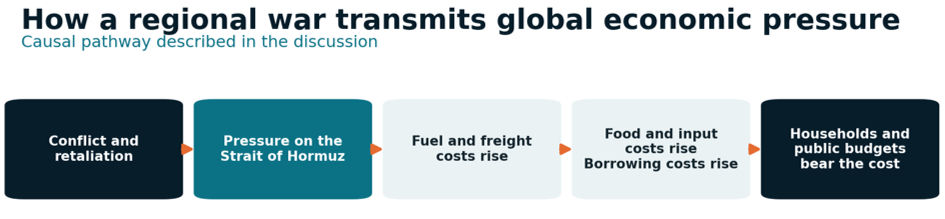
Figure 3: Transmission of conflict-related economic pressure beyond the region
10 WHO WOULD GUARANTEE AN AGREEMENT
Asked what contribution BRICS might make, Professor Milani was candid: as a grouping, a limited one; as individual members, a considerable one, and China above all. China has emerged from this war in a stronger position than any other state. It is the largest economic partner both of Iran and of the Gulf states, and President Xi has signalled an implicit willingness to mediate. In intelligence and military terms, he added, China sits closer to Iran than to the Gulf monarchies. Professor Esterhuyse concurred: China is the one external power with a layered interest here, economic, strategic and opportunistic at once.
The significance of this is less about mediation than about guarantee. Professor Milani set out why Iran hesitates to return to the table. It has been burned three times. The nuclear agreement of 2015, endorsed by the permanent members of the Security Council, from which an American administration unilaterally withdrew three years later before imposing crippling sanctions. The negotiations of this year, well advanced, during which the United States attacked. And the Memorandum of Understanding, a fourteen-provision document and, on his recollection, the first signed personally by an American and an Iranian president, from which the United States has since withdrawn. Qatar, Oman and Pakistan can mediate. What they cannot do is make an agreement stick.
Professor Esterhuyse went further, and knowingly onto controversial ground, raising a proposal recently aired in the Israeli press: that Russia and China oversee a future understanding between Washington and Tehran, including an arrangement between Washington and Beijing on Iranian oil. He acknowledged how uncomfortable the proposition is. He argued for it regardless, as the available route back to geostrategic stability.
Georgios Kostakos put the objection that such an arrangement invites. A settlement reached only among the United States, Russia and China amounts to a directorate. It resolves the war by dividing the world into spheres of influence, and finds its agreement where those spheres overlap. He asked whether there is a place in this for the United Nations, whose incoming Secretary-General takes office shortly, and for the European Union, which secured the original nuclear agreement and whose economies are directly exposed.
The responses were honest. They were not encouraging. Professor Milani maintained that the core conflict can only be addressed bilaterally, and that the most useful role for the United Nations and the European Union is to press both parties towards direct talks. He invoked the Cold War precedent: Washington and Moscow maintained embassies and normal relations for decades without friendship. Normalisation, not reconciliation, is the realistic object. Professor Esterhuyse did not see the current administration involving either institution. On NATO he was unambiguous: its focus is Ukraine, Central Europe and Russia, and a defensive alliance will not act collectively in a war of this character. The multilateral route is the one most Global South actors have an interest in. It is also the one to which neither speaker could attach much probability.
Table 3: Potential external roles in a negotiated settlement

Source: Synthesis of the report discussion.
11 ISRAEL’S INFLUENCE AND THE PRESIDENT’S DECISION
Daryl Swanepoel asked the counterfactual directly. Absent Israel’s influence, would this war have happened? And given that the war is disliked in the United States and the midterm elections approach, where do the incentives now sit?
Both speakers answered the first question in the same way. Israel’s influence was real and material. Professor Esterhuyse observed that no state possesses Israel’s intelligence penetration of the Middle East and of Iran. Israeli discomfort with an Iranian nuclear capability goes back decades and has been acted on militarily more than once since 1979, and 7 October 2023 hardened that reading. On it, the nuclear question served as the argument that brought the Americans across the conventional line.
Professor Milani noted that the Israeli prime minister has been candid about urging successive American administrations to act, and that every president from Carter to Biden declined - including the first Trump administration, which withdrew from the nuclear agreement but did not attack. Professor Esterhuyse described the American system as designed to bring collective decision-making to bear. Influence is not decision. The decision belonged to the President of the United States, and so does the responsibility.
On timing, the incentives point in opposite directions. Rising oil prices improve the opposition’s prospects in the House, less certainly in the Senate, and Tehran understands this. Both took Mr Swanepoel’s further observation seriously: an administration that has lost the midterms is an administration with fewer restraints, and Professor Milani allowed that an impeachment attempt might give the president more incentive to escalate. Professor Esterhuyse added that Iran has reason to extend the conflict regardless of any election, because the second great vulnerability of American power, after its difficulty converting operational success into political outcomes, is the will of the American public. That vulnerability was exploited in Vietnam. It is being exploited now.
Both warned against the assumption that removing the Iranian government would end the matter. Afghanistan absorbed two decades and $1.7 trillion, and the Taliban returned; Iraq is its own answer. Collapse in Iran most likely means civil war, and while Iran and the United States are not at peace the Persian Gulf will not be at peace by itself. Professor Milani put a question worth repeating. Name another state that has endured four decades of crippling sanctions, been attacked by the foremost military power in the world and the foremost in the region, had its leader and its military and intelligence chiefs killed - and survived. The point is not the extent of the government’s support, which he put at between fifteen and twenty per cent. It is that the support is ideological rather than soft, and that the state has institutionalised itself well beyond any single figure.
12 NATIONALISM AND NUCLEAR WEAPONS
Mr Mohmmad Taher Gholi Tabar, joining from Iran, described a unity across cultures, faiths and political positions that he had not previously witnessed in his country. He was candid about the ambivalence in it: that many innocent people, including children, have been killed, and that the attacker has nonetheless united the country. He asked whether this might be the final war between Iran and the United States, and whether Iran would withdraw from the Treaty on the Non-Proliferation of Nuclear Weapons.
Professor Milani confirmed the observation and placed it in historical company. Saddam Hussein attacked Iran in September 1980, on intelligence that the revolution had left the country weak and its factions at each other’s throats, and gave the revolution a new lease of life instead. The French and Russian revolutions taught the same lesson: an external attack consolidates what it means to destroy. Governments come and go, and Iran has seen hundreds of dynasties across three and a half thousand years. People may hate their government and love their country. An external attack asks them to choose. They choose the country. On whether this will be the last such war, he was brief: he hopes so, and does not think so.
On the nuclear question both speakers were sober. Professor Milani considered withdrawal from the NPT secondary to the atmosphere the war has created. Following the domestic debate closely, he reported hearing young Iranians argue for the first time, and in numbers, that Iran has no choice but to build a weapon, because a state without one can be humiliated. Whether the leadership takes that decision he declined to predict. Opinion, he said, has moved further towards weaponisation than at any point he can recall.
Professor Esterhuyse reached the same place by the strategic route, and then went beyond it. If Iran lacked a reason to pursue a weapon before the attack, it has one now, and he expects it to pursue one. He framed the matter through the counterfactual every government in the region is presumably now weighing: would the United States have attacked an Iran that possessed a nuclear weapon? The utility of nuclear weapons has never lain in their use. It lies in possession, and in the deterrence possession confers. He then suggested - and the argument is his, not the meeting’s - that an Iranian deterrent might contribute to the regional balance, between Sunni and Shia, between Arab and Persian, between Israel and its Arab neighbours, that has historically accompanied the Middle East’s more stable periods.
This final note itself is a finding. When a serious strategic analyst can propose in an open forum that further nuclear proliferation is a route to regional stability, and can do so in the expectation of being taken seriously rather than dismissed, the proposition tells us less about his judgement than about the ground on which it is now made. It is a measure of how far that ground has shifted.
13 THREE PATHS, AND WHAT EACH REQUIRES
Professor Milani set out the alternatives as he sees them. The first is prolonged attrition, in which each side gambles that the other has the lower tolerance for economic pain. The second is intensified economic warfare, which both parties are already waging and which he expects to lead nowhere. The third is a return to negotiation. He has long held that there is no military solution to this conflict, only a political one, and he attached a caveat to the word diplomacy. It is not the dictation of terms. It is give and take. An agreement Iran is invited to accept rather than to negotiate will not hold, and after three withdrawals from three arrangements the demand for reciprocity is not posturing.
Professor Esterhuyse reached the same conclusion by the military route. Citing Lawrence Freedman’s argument that the American president has run out of options, he observed that the objectives of this war were never clearly articulated, that early expectations proved over-optimistic, and that strategic reality has since constrained political ambition. No path of escalation remains that does not carry major global consequences. Negotiation is unavoidable, and an exit requires compromise. His formulation: the American president needs to learn the diplomacy of losing well. What that requires is a combination rather than a single instrument. Internal political pressure in both capitals. Economic measures. International diplomacy. And - in his own blunt phrase - that Israel be kept under control.
Table 4: Three possible paths from the current conflict

Source: Synthesis of the report discussion.
14 REFLECTION
The thread running through the September meeting was the distance between military superiority and strategic achievement. The most powerful military coalition in the world has spent six months, two campaigns and fifty-two days of bombardment against Iran, and has not obtained what it went to war for. The nuclear programme has not been eliminated. The government has not fallen. The missile and drone capability persists. And the one unambiguous change in the strategic balance runs the wrong way.
What gives that assessment its weight is that it was reached twice, independently. A specialist in Iranian politics working in an American university and a military strategist working at a South African academy share no discipline, no continent, no formation and no audience. Yet on the character of the war, on its origins in 2003, on the primacy of geography, on the limits of every instrument of force, on the consequences of collapse and on the necessity of negotiation, they said the same things in different vocabularies.
The lesson reaches beyond this conflict, and it is one the Global South has learned repeatedly at its own expense. Force can destroy. It cannot govern. Professor Esterhuyse’s caution against over-dramatising the present should not obscure what is already legible: the constraints that held this relationship below the conventional threshold have been removed, and removing them proved far easier than restoring them will be. A threshold crossed cannot be uncrossed by declaration. It has to be rebuilt, by parties who no longer trust one another, under the supervision of powers whose own interests are engaged.
The gravity of the moment is best measured by what has become sayable within it. A war has produced a surge of nationalism in the country it was meant to destabilise, and an argument for nuclear acquisition in the country it was meant to disarm. Non-proliferation has held for decades on the understanding that possession invites danger rather than confers safety. Six months of this war have made the opposite case more persuasively than any state ever argued it.
For the Global South the implications are immediate rather than theoretical. The world is paying for this war: in fuel, in freight, in food, in the cost of borrowing, and in the erosion of the multilateral mechanisms through which smaller states exercise what influence they have. Should the war be resolved by a directorate of great powers, as Mr Kostakos cautioned, the resolution will confirm a distribution of authority in which most of the world is spectator to decisions that determine its conditions.
Beneath the strategic accounting sit the people. Iranians are being killed, including the children that the participant from Iran mentioned without emphasis and without rhetorical use. Families across the region and far beyond it are absorbing costs generated in rooms they will never see. The proper response to a war that has settled nothing is not resignation. It is to say, from every platform available, that force has failed on its own terms, that negotiation is the only route remaining.

This report has been published by the Inclusive Society Institute on behalf of the Global South Perspectives Network
The Global South Perspectives Network (GSPN) is an international coalition founded in 2022 by HumanizaCom, the Foundation for Global Governance and Sustainability (FOGGS), and the Inclusive Society Institute (ISI). It connects think tanks and experts from Latin America, the Caribbean, Africa and the Middle East to bring a wider range of Global South perspectives into debates on international affairs and global governance.
GSPN was established in response to the need for stronger Southern representation in the institutions and discussions that shape global policy. Its work focuses particularly on United Nations reform and the future of multilateralism. The network provides a space for experts from different regions to exchange ideas, identify shared priorities and contribute proposals grounded in their own experiences.
Through research, dialogue and advocacy, GSPN seeks to broaden participation in global decision-making. It also promotes more equitable partnerships between the Global South and North, recognising that effective responses to international challenges require the knowledge and participation of countries across both.
Among GSPN’s initiatives is the 2023 report Global South Perspectives on Global Governance Reform, which was presented at a United Nations workshop in New York. The network has also contributed to international dialogue through events including a United Nations civil society workshop held in Nairobi in 2024.
GSPN’s mission is to help ensure that Global South countries participate as equal partners in shaping global policy. By connecting perspectives across regions and bringing them into international discussions, the network works towards a fairer, more inclusive and more sustainable international order.
Email: info@inclusivesociety.org.za
Phone: +27 (0) 21 201 1589


Revisar resultados anteriores puede ser útil para conocer cómo han variado los sorteos. Las números calientes pueden llamar la atención cuando se comparan diferentes jornadas y se analiza la frecuencia con la que aparecen determinados números.
I really enjoyed reading this content. Thank you for providing such unique and useful information. Your point of view is excellent, and I fully agree with what you've shared. Thanks for sharing your thoughts with us! Coraline Raincoat
Có lần mình đang xem vài bài chia sẻ trên mạng thì thấy mọi người nhắc đến NK88 nên tiện tay bấm vào xem thử. Mình cũng không ngồi đọc hết nội dung, chủ yếu nhìn qua cách trang chia từng khu vực và bố trí menu. Cảm giác đầu tiên là giao diện khá thoáng, các phần có khoảng cách vừa đủ nên kéo xuống không thấy bí hay rối. Mỗi khu vực được tách riêng thành từng khối, nhờ vậy mình chỉ cần nhìn sơ cũng biết phần đó nằm ở đâu. Menu được đặt khá dễ tìm nên khi muốn chuyển sang mục khác cũng không phải mất công tìm kiếm. Mình chỉ lướt qua một lúc nhưng…
The content was truly engaging and informative. I sincerely appreciate you for sharing such valuable insights. You made an excellent point, and I completely agree with your perspective. Thank you for contributing this helpful information. Harley Quinn Jacket
Good punjabi shayari boy content should have variety, and this collection offers expressions for different personalities and moods. Some lines communicate confidence, while others focus on friendship and emotions. I liked the natural Punjabi style because it keeps the poetry authentic and easy to connect with. These lines could be useful for social media captions, status messages, or casual conversations with friends. Overall, they provide a creative way to express thoughts through short and memorable Punjabi poetry.