


TRUE SOUTH AFRICA - Evidence Series: Crime, Safety and Institutional Capacity
Updated: Jun 30


Copyright © 2026
Inclusive Society Institute
PO Box 12609
Mill Street
Cape Town, 8010
South Africa
235-515 NPO
All rights reserved. No part of this publication may be reproduced
or transmitted in any form or by any means without the permission in
writing from the Inclusive Society Institute
DISCLAIMER
Views expressed in this report do not necessarily represent the views of
the Inclusive Society Institute or its Board or Council members.
This report was prepared with the assistance of AI technology, including ChatGPT.
JUNE 2026
Author: Inclusive Society Institute
CONTENTS
Executive Summary: What the evidence actually shows
Introduction
Methodology and data approach
PART I: Crime outcomes: What has happened
PART II: State capacity and institutional strain
PART III: Accountability, legitimacy and trust
PART IV: Inequality, privatisation and the shape of safety
PART V: Misdiagnosis, missteps and the path back to stability
Conclusion: Strain, stabilisation and the responsibility of realism
References
Annexure A
Cover image: Microsoft Copilot (2026) Education in South Africa. AI generated image
LIST OF FIGURES
Figure 1: Murder rate per 100,000 population, 1994/95–2023/24
Figure 2: Murder rate per 100,000 population, 2019/20–2023/24
Figure 3: Serious assault rate per 100,000 population
Figure 4: Theft out of motor vehicles rate per 100,000 population
Figure 5: Aggravated robbery rate per 100,000 population
Figure 6: Residential burglary rate per 100,000 population, 1994/95 and 2023/24
Figure 7: Reported sexual assault cases per 100,000 population, 1994–2024
Figure 8: Farm murders in South Africa, 1994–2023
Figure 9: Farm murders in South Africa, 2019–2023
Figure 10: Citizens per sworn police officer (1997 - 2024)
Figure 11: Police officers murdered
Figure 12: Deaths as a result of police action or in custody
Figure 13: Public perceptions of safety
Figure 14: Public vs private security personnel
EXECUTIVE SUMMARY: WHAT THE EVIDENCE ACTUALLY SHOWS
South Africa is not a crime-free society, but it is not a society in free fall. Crime remains a serious challenge, but the evidence does not support claims of inevitable collapse or permanent deterioration.
Much of the despair about crime is driven by how numbers are reported, not only by what is happening. Absolute crime numbers rise in a growing population. This alone does not mean that South Africans are becoming less safe.
When crime is measured properly, using rates and ratios, the picture changes materially. Population-adjusted indicators show that several major crime categories are substantially lower today than during the early democratic period
The murder trend tells a more positive long-term story than is commonly acknowledged. Murder rates today are significantly below their mid-1990s and early-2000s levels. While post-pandemic increases reversed some gains, recent stabilisation shows that deterioration is not linear, nor irreversible.
Everyday violent and property crimes show some of the clearest improvements. Serious assault, residential burglary and theft out of motor vehicles have all declined markedly from their historical peaks, despite year-to-year volatility.
Sexual violence remains one of South Africa’s gravest social failures, but even here the data resists simplistic despair. Reported sexual offences peaked in the mid-2000s and have declined over time, highlighting both real progress and the complexity of reporting behaviour.
Aggravated robbery is the most persistent exception, harmful, visible and difficult to suppress. Yet, even this category remains well below its historical peak and only slightly higher than at the advent of democracy, indicating persistence, rather than runaway escalation.
Farm murders are rare in absolute terms and have declined from earlier peaks, and whilst each incident is traumatic and unacceptable, the long-term trend does not support claims of exponential growth or systemic targeting; it must be understood in proportion to overall violent crime trends.
Policing capacity has been strained, but not destroyed. The trends show that the number of citizens per police officer revealed improvements, but again worsened over the past decade. Recent improvements point, however, to partial recovery, rather than terminal decline.
Independent oversight remains operational and the trends show that fluctuations in deaths as a result from police action or custody, reflects pressure and context, but its mechanisms continue functioning and remain accountable.
The growth of private security reflects inequality more than state collapse, it signals uneven access to safety and not the disappearance of public policing.
Public fear remains high, but uneven, with most South Africans feeling safe during the day, but unsafe at night. Perceptions have stabilised, rather than improved, once again reflecting strain, not collapse.
The evidence points to strain and uneven outcomes, not inevitability. South Africa’s crime story is one of progress made, progress eroded, and progress still possible.
Despair is understandable, but it is not the only rational response. Where improvement has occurred before, it can occur again. Evidence-based realism is the foundation of recovery and hope.
A NOTE ON CONTEXT
South Africa is widely described as a country in decline, even a country in collapse. Public debate, media commentary and everyday conversation are saturated with the language of failure: a failed state, a failed government, a society coming apart at the seams. That is the dominant public perception. This report was developed precisely to test that perception against evidence. It asks a simple question: when we look carefully at the data, when we measure performance, rather than emotion, does the story of collapse hold?
The evidence does not support that conclusion. What it shows instead is a country under real and sustained strain, economically, socially and institutionally, but not a country that has collapsed, and not a state that has failed. The challenges are serious and should not be minimised, yet they coexist with resilience, capacity and untapped potential. South Africa’s outcomes are weaker than they should be, but stronger than public perception suggests. With a firmer growth path, improved institutional performance and greater policy consistency, the trajectory can change. This report therefore argues for realism without despair: less denial of strain, but also less surrender to hopelessness. South Africa warrants more honesty and more confidence than the prevailing narrative allows.
INTRODUCTION
South Africa is living through a period of profound anxiety about its future. Crime features prominently in this unease, often serving as shorthand for much broader concerns about governance, social cohesion and the viability of the democratic project itself. In public discourse, particularly beyond our borders, these anxieties are increasingly distilled into a single, fatalistic claim: that South Africa is a failed state, a country in irreversible decline.
This report begins from a different premise. It accepts, without qualification, that South Africa faces serious and persistent crime and safety challenges. It acknowledges that progress has been uneven, that important gains have been reversed, and that too many citizens experience violence, not as an abstraction, but as a daily reality. What it does not accept is that deterioration is inevitable, that institutions have collapsed beyond repair or that despair is a reasonable substitute for analysis.
The True South Africa evidence series is premised on a simple, but demanding idea: that national self-assessment should be grounded in data, historical perspective and institutional realism, rather than anecdote, outrage or selective comparison. This first report focuses on crime, safety and policing capacity, because these issues sit at the heart of public confidence. They shape how citizens experience the state, how communities relate to one another, and how the country is perceived by the world.
Crucially, this report does not ask whether South Africa has solved its crime problem. It plainly has not. Instead, it asks a more difficult and more useful question: do the available trends point toward collapse and inevitability or toward strain within a system that still retains the capacity for correction and improvement? The distinction matters, because only the latter leaves room for agency, reform and responsibility.
This is the first report in a broader series that will examine education, health and economic performance with the same methodological discipline and refusal to surrender to either denial or despair. Together, they aim to re-anchor national debate in evidence, proportionality and confidence rooted in realism.
METHODOLOGY AND DATA APPROACH
This report draws on publicly available, verifiable crime, population and institutional data compiled in the Crime and Security chapter of the March 2025 Socio-Economic Survey of South Africa. That chapter integrates and standardises primary data drawn from official sources, including South African Police Service crime statistics, Statistics South Africa population and victimisation data, Independent Police Investigative Directorate reporting, and published personnel figures used to assess policing capacity.
The Socio-Economic Survey (CRA, 2025) does not generate original crime statistics. Rather, it collates, cleans and presents primary administrative and survey data produced by these institutions in a consistent and transparent format. The analysis in this report is therefore based on secondary analysis of primary data, as compiled and verified in the Crime and Security chapter of the Survey.
Two time horizons are used throughout the report. The first examines long-term trends from the early democratic period to the most recent available year, allowing assessment of structural change over time. The second focuses on the period from roughly 2019 onward, capturing recent volatility, pandemic-era distortions and post-pandemic stabilisation dynamics. Where full year-by-year series are not available in published form, selected benchmark years are used transparently and explicitly.
No data has been extrapolated beyond published sources. No missing values have been inferred or smoothed. Absolute numbers are used where rates would be misleading, and population-adjusted rates and ratios are used where scale and comparability require them. The intention throughout is not to produce the most flattering picture possible, but the most defensible one.
PART I
CRIME OUTCOMES: WHAT HAS HAPPENED
ABSOLUTE NUMBERS, POPULATION GROWTH AND THE PROBLEM OF FALSE COMPARISON
Public debate about crime in South Africa often begins with numbers that appear self-evident and alarming. Headlines point to increases in the absolute number of crimes recorded and these raw counts are frequently taken as conclusive proof that the country is becoming steadily more violent. This report begins from a different starting point: before assessing what has happened to crime, it is necessary to be clear about how crime data should be read.
A significant contributor to public despair is not only the level of violence itself, but the way crime data is routinely presented and interpreted. Media reporting, political commentary and social discourse frequently focus on absolute numbers of crimes committed, treating increases in raw counts as self-evident proof of deterioration. In a country that has experienced rapid population growth over three decades, this approach is not merely misleading, it is analytically unsound.
South Africa’s population today is vastly larger than it was at the advent of democracy. At the time of the first democratic elections in 1994, the country’s population stood at approximately 40-44 million people (Stats SA, 1998), but by 2024, South Africa’s population had grown to just over 63 million (Stats SA, 2024). In other words, the country today has around twenty million more people than it did at the start of the democratic era, an increase of close to 50 per cent.
This demographic reality matters profoundly for how crime data is understood. All else being equal, a larger population will generate more incidents of almost every social phenomenon, including crime. This is not a peculiarity of South Africa, nor a controversial proposition. It is a universal demographic truth. When the number of people increases substantially, the absolute number of offences can rise even if the risk faced by any individual citizen remains unchanged or even declines.
For this reason, raw crime counts tell us very little about whether a society has become more or less violent in any meaningful sense. They do not measure risk, probability or exposure and they cannot distinguish between a society that is becoming more dangerous and one that is simply larger. Treating absolute numbers as evidence of decline therefore conflates population growth with institutional failure, which amplifies anxiety, whilst it obscures the underlying dynamics.
A more sober, and more honest, assessment requires the use of rates and ratios: crimes per 100,000 population, citizens per police officer, or comparable measures that adjust for scale. These indicators allow like-for-like comparison across time. They tell us whether the likelihood of victimisation has increased or decreased, rather than how many incidents occurred in total.
Throughout Part I of this report, crime outcomes are therefore assessed using population-adjusted measures wherever possible. This is not a technical preference, but an analytical necessity. Only once the question of scale is addressed can the evidence speak meaningfully to whether South Africa’s crime trajectory reflects collapse, strain, stabilisation or the possibility of recovery.
VIOLENCE IN LONG-RUN PERSPECTIVE
South Africa entered democracy with levels of violence that were exceptionally high by international standards. The mid-1990s represent not a neutral baseline, but the inherited legacy of decades of social fracture, political conflict and institutionalised inequality. Any serious assessment of progress must therefore begin by recognising the depth of the challenge at the starting point.
The long-run trajectory of murder rates since the mid-1990s reveals a pattern that resists simplistic interpretation. A substantial and sustained decline in crime occurred over the first decade and a half of democracy, reflecting improvements in policing, stabilisation of political violence and the gradual consolidation of state authority. By the early 2010s, murder rates had reached their lowest levels since the transition.
That progress was not maintained. The subsequent period saw a clear reversal, coinciding with broader patterns of institutional weakening, declining state capacity and erosion of public trust. In recent years, murder rates have risen from their post-2010 low point and remain unacceptably high and yet, it is equally important to note what the data does not show. Current levels, while deeply concerning, are still materially below those recorded at the outset of democracy in the early 1990s, which means that the system is volatile and strained, but not exponential and/or uncontrolled.

Figure 1: Murder rate per 100,000 population, 1994/95–2023/24
(Source: graphics – author; data – CRA, 2025)
This figure shows the long-term trajectory of South Africa’s murder rate from the early democratic period to the most recent available year, where murder rates were exceptionally high in the mid-1990s, then they declined substantially over the following decade and a half, rising again during a period of institutional weakening; and whilst current levels remain unacceptably high, they are still materially below those recorded at the start of democracy in the early 1990s, which points to a system under strain and gain reversal, rather than a system that has collapsed. |
This distinction is essential, in that a narrative of collapse implies a system that has lost all capacity for containment and correction. The evidence points instead to a system under pressure, capable of improvement, but vulnerable to regression when capacity and leadership falter.
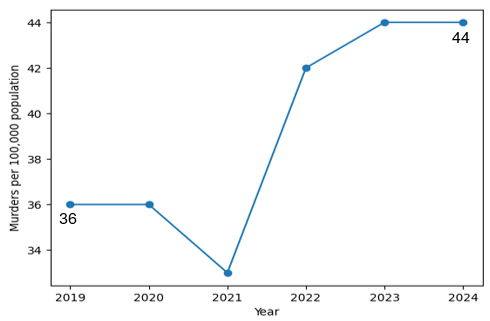
Figure 2: Murder rate per 100,000 population, 2019/20–2023/24
(Source: graphics – author; data – CRA, 2025)
This figure focuses on the most recent period, capturing pandemic-related disruption and post-pandemic stabilisation. While murder rates increased from the unusually low level recorded during lockdown conditions, the trend over the past two years has been broadly stable, rather than accelerating. This pattern is consistent with institutional strain and volatility, not uncontrolled deterioration. |
EVERYDAY VIOLENCE AND LIVED SAFETY
Murder statistics rightly attract attention, but in reality they represent only a small fraction of the overall violence that citizens are experiencing. Serious assault offers a broader window into everyday harm and lived insecurity in that it captures violence that may not make headlines, but which profoundly shapes how people experience their communities, workplaces and public spaces.
For this category of crime, the long-run picture is more clearly one of improvement. Serious assault rates in the mid-1990s were extraordinarily high, reflecting pervasive interpersonal violence, but over time, these rates declined sharply, reaching levels that are roughly half of what they were at the dawn of democracy. As with murder, setbacks occurred and progress was not linear and yet, even after recent volatility, serious assault remains far below its historical peak.

Figure 3: Serious assault rate per 100,000 population
(Source: graphics – author; data – CRA, 2025)
This figure illustrates changes in the rate of serious assault over time and it captures both long-term improvement and recent volatility. Serious assault rates have declined substantially since the mid-1990s and remain roughly half of their early democratic levels. While progress has not been linear and recent years reflect stabilisation, rather than rapid improvement, the long-run reduction is significant and sustained. |
This matters because it demonstrates that large-scale behavioural and social shifts are possible. It also complicates claims that South Africa is uniformly more violent today than in the past. The reality is more uneven, more demanding of nuance, and more instructive for policy.
PROPERTY CRIME AND OPPORTUNITY
Theft out of motor vehicles provides insight into a different dimension of safety: opportunistic crime closely linked to urban design, visibility, routine activity and policing presence. In the mid-1990s, this category of crime was extremely prevalent and it affected large numbers of households, thereby contributing to pervasive insecurity.
Over time, the rate of theft out of motor vehicles declined substantially, falling to a fraction of its early democratic levels by the late 2010s. The pandemic years introduced temporary distortions, but recent data shows stabilisation at historically lower levels. This trajectory is significant precisely because it reflects cumulative institutional learning, rather than isolated interventions.
Property crime of this nature responds to design, deterrence and routine enforcement. Its long-term decline illustrates that sustained, incremental improvements can yield durable results, even in a complex social environment.
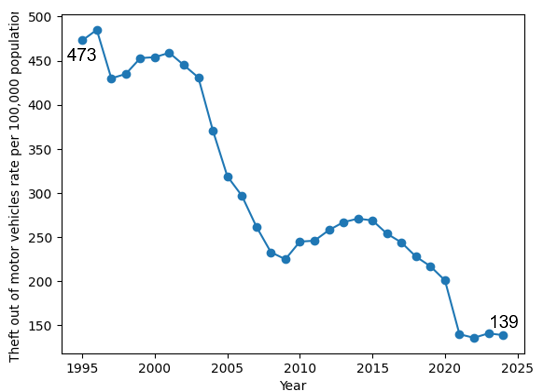
Figure 4: Theft out of motor vehicles rate per 100,000 population
(Source: graphics – author; data – CRA, 2025)
This figure shows the long-term reduction and recent stabilisation in theft out of motor vehicles, where rates in the mid-1990s were exceptionally high, but which declined sharply over time and which has now stabilised at much lower levels in recent years. The pattern reflects cumulative gains in everyday crime prevention and deterrence, rather than short-term suppression. |
THE UNFINISHED CHALLENGE OF AGGRAVATED ROBBERY
If some indicators point toward improvement, aggravated robbery represents the counterweight that prevents complacency. Unlike murder, serious assault, residential burglary and theft out of motor vehicles, all of which declined substantially from their mid-1990s levels, aggravated robbery has proven more resistant to sustained reduction.
That said, proportion matters, because whilst the trend shows that aggravated robbery rates are slightly higher today than at the advent of democracy, they remain considerably below their historical peak, which occurred during the late 2000s. The long-run pattern is therefore not one of unchecked escalation, but of elevated persistence within a bounded range, punctuated by periods of increase and partial retreat.
This distinction is important. In absolute terms, aggravated robbery stands out because it did not follow the steep downward trajectory observed in several other major crime categories. In relative terms, however, its deviation from early democratic levels is modest, particularly when compared to the scale of decline achieved elsewhere. The intensity of its fluctuation over time is therefore lower than commonly assumed, even as its impact on victims remains severe.
Temporary reductions during periods of restricted movement underscore how sensitive this category is to opportunity structures, mobility and firearm availability. The rebound that followed illustrates the limits of short-term suppression in the absence of sustained disruption of organised criminal networks and thus aggravated robbery highlights a specific and enduring enforcement challenge within an otherwise uneven crime landscape, rather than evidence of generalised collapse.
Including this category is essential precisely because it resists simple narratives. It shows that progress in South Africa’s crime profile has been real, but incomplete, unevenly distributed across offence types, and vulnerable where institutional capacity, deterrence and disruption of organised crime have lagged. This complexity reinforces the central theme of this report: strain and persistence, rather than inevitability or systemic failure.

Figure 5: Aggravated robbery rate per 100,000 population
(Source: graphics – author; data – CRA, 2025)
This figure shows trends in aggravated robbery since the advent of the new political dispensation. Unlike several other crime categories, aggravated robbery rates are slightly higher today than they were in the mid-1990s, despite temporary declines during periods of restricted movement. The temporary decline was followed by a rebound, underscoring the structural nature of this challenge and the limits of short-term suppression, but even so, the pattern highlights uneven institutional performance, rather than systemic collapse. |
RESIDENTIAL BURGLARY AND THE INVASION OF PRIVATE SPACE
Residential burglary occupies a particular place in how crime is experienced and understood by citizens. Unlike crimes that occur in public or at a distance, burglary is felt as a violation of the most basic expectation of safety: that one’s home offers a measure of refuge. For this reason, residential burglary has an outsized psychological impact relative to its share of overall crime, shaping fear, behaviour and perceptions of national decline.
From an analytical perspective, residential burglary is also revealing, because it sits at the intersection of opportunity, deterrence and routine activity. It is influenced by visibility, patrol presence, neighbourhood design and predictability of response. As such, it is often more sensitive to cumulative institutional capacity than to short-term enforcement surges. Trends in residential burglary therefore offer insight into whether everyday crime prevention has weakened irreversibly or remains responsive to governance choices.
The long-run data provides important context. Residential burglary rates were extremely high in the mid-1990s, reflecting both inherited social conditions and limited preventative capacity at the outset of democracy, but over time, these rates declined substantially. While progress was uneven and interrupted by periods of volatility, the most recent data shows that residential burglary rates remain materially lower than those recorded at the beginning of the democratic period.
This does not mean that residential burglary is no longer a serious problem, because it remains a major driver of fear and behavioural change, particularly because of its intimate nature and the sense of violation it produces. However, reading this indicator in historical proportion is essential. The long-term reduction demonstrates that improvement has been possible and that residential crime has responded to cumulative changes in deterrence, design and institutional learning.
Interpreted in this way, residential burglary reinforces the central argument of this report. It underscores the seriousness of lived insecurity while also challenging the claim that South Africa’s safety trajectory is one of uninterrupted collapse. The pattern points instead to strain within a system that has delivered gains in the past, lost some of them through capacity erosion, and retains the potential for stabilisation when preventative capability is rebuilt.

Figure 6: Residential burglary rate per 100,000 population, 1994/95 and 2023/24
(Source: graphics – author; data – CRA, 2025)
This figure shows the long-term change in residential burglary from the early democratic period to the most recent year, showing that rates were substantially higher in the mid-1990s and have declined over time, despite volatility in the intervening years. The long-run reduction is significant, even as residential burglary remains a key source of fear and lived insecurity. |
SEXUAL OFFENCES: SEVERITY, REPORTING AND LONG-RUN TRENDS
Sexual offences occupy a distinctive and deeply troubling place in South Africa’s crime landscape, since crimes inflict comparable physical harm, psychological trauma and long-lasting social consequences. Sexual violence also shapes patterns of fear, mobility and vulnerability in ways that extend far beyond those directly affected, particularly for women and children, and therefore any serious assessment of safety and insecurity must confront this category directly, without euphemism or evasion.
At the same time, sexual offences present particular challenges for interpretation. Unlike many other crime categories, recorded sexual offences are highly sensitive to reporting behaviour. Fear of secondary victimisation, distrust in institutions, stigma and uneven access to police services all affect whether survivors come forward and therefore reported cases reflect not only the prevalence of violence, but also levels of trust, awareness and institutional responsiveness. This does not weaken the data, but it does require that it be read with care.
Seen in long-run perspective, the recorded data nevertheless reveals an important pattern, being that reported sexual assault cases increased through the late 1990s and early 2000s, reaching a peak in the mid-2000s. Thereafter, the trend shifted, revealing that from roughly the late 2000s onward, reported cases declined steadily, with volatility in the intervening years, but a clear movement away from the earlier peak levels. However, that said, by the mid-to-late 2010s, the recorded number of sexual offences were substantially lower than during the high-point of the previous decade.
The COVID-19 period disrupted this pattern, as it did across much of the criminal justice system due to restrictions on movement, reduced access to police stations and social services, and the broader dislocation of daily life affected both the incidence and reporting of crime. However, in the years immediately following the pandemic, recorded sexual offences show modest fluctuation, but still it remained well below the levels observed during the mid-2000s peak.
It is essential to be precise about what this does and does not mean. The long-run decline in reported sexual offences does not imply that sexual violence is no longer a serious problem, nor does it justify complacency. Under-reporting remains a defining feature of this category, and changes in recorded levels cannot be read as a simple proxy for changes in lived experience. At the same time, the data does not support a narrative of uninterrupted deterioration or runaway escalation. Even in one of the most sensitive and morally charged categories of crime, the long-term pattern is more complex than commonly assumed.
Interpreted in proportion, sexual offence data reinforces the central argument of this report. South Africa’s safety challenges are profound, uneven and often traumatic, but they are not characterised by uniform or irreversible collapse across all dimensions. Progress has been achieved in the past, some of it has been eroded, and some gains have been preserved. Understanding this complexity is not an exercise in minimisation; it is a prerequisite for designing responses that are grounded in evidence, attentive to victims and capable of restoring both safety and trust over time.

Figure 7: Reported sexual assault cases per 100,000 population, 1994–2024
(Source: graphics – author; data – CRA, 2025)
This figure shows the long-term trend in reported sexual assault cases in South Africa from the early democratic period to the most recent year. Reported cases rose through the late 1990s and early 2000s, reaching a peak in the mid-2000s, before declining over time, with volatility in the intervening years and a sharp disruption around the COVID-19 period. While sexual violence remains a deeply serious and under-reported crime, the long-run pattern does not support claims of uninterrupted escalation and highlights the importance of reading reported figures alongside reporting behaviour, institutional trust and access to justice. |
FARM MURDERS: CONTEXT, SERIOUSNESS AND PROPORTION
Few crime issues generate as much heat and as little light as farm murders. These crimes are real, traumatic and morally indefensible and they demand serious attention and effective response, but at the same time, the way they are often represented in public discourse bears little resemblance to the empirical record.
Long-run data shows that farm murders were most prevalent in the late 1990s and early 2000s, with significant year-to-year volatility thereafter, but in recent years, the number of such murders has declined from those historical highest. This is not to say that the problem has dissipated, it has not, it persists and remains deeply distressing for affected communities. What the data does not support, however, are claims of exponential escalation or novel post-1994 targeting, let alone genocide.
Holding these facts together is not an exercise in minimisation. It is an exercise in proportion. Alarmism may mobilise attention, but it also corrodes trust and forecloses the possibility of reasoned response. A bounded problem, however serious, remains one that can be addressed.
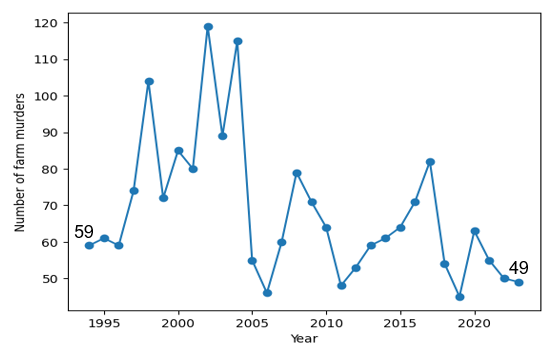
Figure 8: Farm murders in South Africa, 1994–2023
(Source: graphics – author; data – CRA, 2025)
This figure reflects the number of recorded farm (which include farmers, black and white, their family and workers) murders over the long term and shows that farm murders peaked in the late 1990s and early 2000s, followed by substantial volatility and an overall decline from those historical highs. Whist these crimes remain deeply serious and traumatic, the long-run pattern disputes claims of exponential escalation or recent structural change. |

Figure 9: Farm murders in South Africa, 2019–2023
(Source: graphics – author; data – CRA, 2025)
This figure focuses on farm murders in the most recent period, with the data showing year-to-year volatility, rather than a consistent upward trend, and while the number of incidents remains unacceptable, recent figures do not indicate escalation relative to earlier peaks, reinforcing the importance of proportion and historical context when interpreting these crimes. |
PART II
STATE CAPACITY AND INSTITUTIONAL STRAIN
POLICING CAPACITY AND POPULATION PRESSURE
Crime statistics on their own tell only part of the story. To understand why certain trends have stabilised, why others have worsened, and why progress has been so uneven, it is necessary to examine the capacity of the institutions tasked with maintaining public safety. In South Africa’s case, the most revealing measure of this capacity is not expenditure in rands, but the relationship between population size and the number of sworn police officers available to serve it.
ABSOLUTE POLICE NUMBERS AND CAPACITY DRIFT
Changes in per-capita policing capacity are often attributed solely to population growth, but this explanation is incomplete without examining what happened to the absolute number of sworn police officers. In South Africa’s case, the record points not to sudden collapse, but to a period of stagnation followed by gradual contraction.
During the 2000s, the South African Police Service experienced a sustained expansion in sworn personnel, which rose form roughly 104,000-108,000 sworn officers in the early 2000s to a high-water mark of approximately 157,000 sworn officers around 2012. This period coincided with the most favourable per-capita policing ratios in the democratic era and broadly aligned with improvements across several major crime categories.
This trajectory was not sustained. From the mid-2010s onward, recruitment slowed while attrition increased and that resulted in a steady erosion of absolute police numbers. By 2021, the number of sworn SAPS members had again declined to roughly 140,000, despite continued population growth and increasingly complex policing demands. So in absolute terms, this decline represented a reduction of around 17,500 officers from the early-2010s peak.
Importantly, the most recent data also points to a partial recovery, because by 2024, sworn personnel numbers had increased again to approximately 150,000 officers. While this improvement does not fully restore the per-capita policing capacity achieved a decade earlier, it does mark a reversal of the earlier decline and helps explain the modest recent improvement visible in the citizens-to-police ratio.
This shift did not occur abruptly. Rather, it reflected cumulative pressures: fiscal constraint, organisational challenges, difficulties in retaining experienced personnel and competing state priorities. The result was a police service that continued to operate, deploy and adapt, but with progressively fewer officers available to meet growing demand.
Understanding this dynamic is critical. The erosion of policing outcomes in some areas did not occur because the police service ceased to exist or collapsed institutionally, but because capacity stopped expanding at precisely the moment when demographic, social and criminal pressures required it to do so. The system remained intact, but increasingly stretched.
Seen in this light, South Africa’s safety challenge is better understood as one of capacity drift, rather than institutional failure. The data shows a functioning police service operating under rising strain, which reinforces the central conclusion of this report, which is that deterioration was neither inevitable nor irreversible, but the result of identifiable choices and constraints.
PER-CAPITA POLICING CAPACITY AND POPULATION GROWTH
Over the long run, South Africa’s policing capacity relative to population growth has followed a non-linear trajectory, which has reflected both deliberate policy choices and broader structural pressures. In the late 1990s and early 2000s, the number of people in the country per police officer increased (primarily as a result of population growth that outpaced the expansion of the police service) and this placed a growing strain on front-line policing capacity. In tandem, the levels of serious crime rose, but from the mid-2000s onwards, the trajectory shifted into positive territory, which ushered in a sustained period of personnel recruitment and institutional expansion, that resulted in measurable improvements in per-capita policing capacity. This saw the number of people per police officer decline steadily until reaching its most favourable point in the early 2010s. An important observation drawn from the data is that this period coincided with improvements across several major crime categories. This reinforced the intuitive link between policing capacity, on the one hand and deterrence and outcomes, on the other.
But from approximately 2012 onwards, this progress in the strengthening of police officer numbers again began to reverse. Population growth, fiscal constraints and organisational challenges combined to erode per-capita capacity once more. The number of people per police officer increased steadily through the latter half of the 2010s, a trend that was intensified during the COVID-19 period, when extraordinary social disruption placed additional demands on an already strained system. As a result, fewer officers were required to serve larger, more complex and more demanding policing environments than had been the case a decade earlier.
Importantly, however, the most recent data points do not suggest an unchecked or irreversible decline. In the latest reporting years, the number of people per police officer has declined again, indicating a modest, but meaningful improvement in per-capita capacity. While current levels remain less favourable than those achieved at the peak of expansion in the early 2010s, this recent improvement underscores a central theme of this report: the police service is under strain, but it has not collapsed, and its trajectory is neither fixed, nor uniformly negative.
The implications of these shifts are significant, since periods of declining capacity force difficult trade-offs, because reactive responses tend to crowd out preventative work, visible policing gives way to case management and morale, and retention, suffer under sustained workload pressure. Yet, the historical record also demonstrates that capacity can be rebuilt, that improvements are possible within the existing institutional framework and that outcomes respond to changes in resourcing and organisation. The evidence therefore points not to institutional failure, but to the consequences of allowing policing capacity to lag persistently behind demand, and to the possibility of stabilisation and recovery when that gap is addressed.

Figure 10: Citizens per sworn police officer (1997 - 2024)
(Source: graphics – author; data – CRA, 2025)
This figure shows changes in the ratio of citizens to sworn police officers over time. Policing capacity improved steadily through the 2000s, reaching its most favourable levels in the early 2010s. Since then, population growth, fiscal constraint and organisational pressures have reversed these gains, increasing the number of citizens each officer is responsible for. An improvement is however again registered in the last few years. The trend helps explain why crime outcomes have stabilised in some areas despite growing institutional strain. |
Understanding this dynamic is essential to interpreting crime trends honestly. Stabilisation in some crime categories has occurred, not because capacity has improved, but despite the fact that it has deteriorated. That distinction reinforces the case for reform, rather than resignation.
THE HUMAN COST OF POLICING
Behind every discussion of capacity lies a human reality. Policing is inherently dangerous work, particularly in societies characterised by high levels of violence and inequality and in this regard, the number of police officers murdered in the line of duty offers a stark reminder of the risks borne by those tasked with enforcing the law.
Here again, a long-term perspective matters, because when analysing the trends over time it reveals that police killings were significantly higher in the late 1990s and early 2000s than they are today and one can presume, one supposes, due to, improvements over time in training, equipment and operational practice, all of which contributed to a sustained reduction in fatalities among officers. By the late 2010s, police murders had fallen to roughly half of their earlier peak levels.
Recent years have seen a modest rebound and stabilisation, rather than a return to historical highs. The danger faced by police officers remains real and unacceptable, but it has not escalated uncontrollably and it is indicative of a pattern that mirrors the broader crime trends, namely progress achieved, gains partially eroded, but institutional function preserved.
This matters not only for the safety of the officers themselves, but also for the legitimacy and sustainability of policing as a profession, because a society that demands effective law enforcement, while ignoring the risks and pressures faced by those who deliver it, creates conditions for burnout, withdrawal and mistrust. Recognising the human cost of policing is therefore not an indulgence; it is a prerequisite for rebuilding capacity and confidence.

Figure 11: Police officers murdered
(Source: graphics – author; data – CRA, 2025)
This figure shows the number of police officers murdered over selected benchmark years. Fatalities were significantly higher in the late 1990s and early 2000s, declined steadily over time, and have stabilised in recent years; and while policing remains dangerous work, the long-term trend points to institutional adaptation and resilience, rather than escalating collapse. |
PART III
ACCOUNTABILITY, LEGITIMACY AND TRUST
Debates about crime and policing in South Africa often collapse into a false binary between enforcement and accountability, as if the two were competing objectives, rather than mutually reinforcing ones, but in reality, the legitimacy and effectiveness of policing depend on the presence of credible oversight mechanisms that regulate the use of force, investigate misconduct and sustain public trust. The existence and functioning of such mechanisms are among the clearest indicators separating states under strain from those that have genuinely failed.
South Africa’s Independent Police Investigative Directorate occupies this critical space of accountability. Its mandate is neither to shield the police from scrutiny, nor to assume guilt in advance, but to ensure that deaths resulting from police action or occurring in police custody are systematically recorded, investigated and subjected to public oversight. The data generated through this process is frequently misunderstood and often misused, particularly in public debate that seeks either to condemn or defend institutions in absolute terms.
Over the past decade, the number of deaths reported to oversight authorities has fluctuated, rather than following a single directional trend. Periods of increase have been followed by periods of reduction, and then increases again, thereby underscoring the sensitivity of this indicator to enforcement intensity, social disruption and operational context. A notable spike was registered around the 2019-2020 period, coinciding with the wider social disruption and intensified enforcement under emergency conditions at the time. Subsequent years did not settle into a simple decline, reinforcing that this measure is best interpreted as a context-responsive oversight indicator, rather than a linear story of either collapse or improvement.
What this data does not tell us is who was at fault in individual cases, whether deaths resulted from misconduct, or how many led to prosecution. Those questions belong to a different analytical layer. What the data does show is that oversight exists, that incidents are recorded, and that trends are visible, rather than hidden. In societies where the state has collapsed, deaths involving law enforcement disappear into silence. In South Africa, they remain part of the public record.

Figure 12: Deaths as a result of police action or in custody
(Source: graphics – author; data – CRA, 2025)
This figure shows the number of deaths reported to the Independent Police Investigative Directorate over selected years. The data reflects fluctuations, rather than a sustained upward trend, with a notable spike around the 2019–2020 period, which was again followed by continued fluctuation. |
This distinction is critical. The presence of oversight, even where imperfect, reflects an institutional commitment to legality and accountability and so the challenge does not lie in resurrecting a system that no longer exists, but instead, in strengthening one that does operates, albeit under strain and heightened public expectation.
If accountability speaks to institutional legitimacy, public perception speaks to lived legitimacy and so even though crime statistics may stabilise or even improve, fear may linger long after the conditions have change. In South Africa, this gap between measurable trends and subjective experience is particularly pronounced, in that ot is shaped by historical trauma, inequality and the amplification of episodic violence through media and social platforms.
Perceptions of safety in South Africa are sharply differentiated depending on the time of day. A strong majority of adults report feeling safe walking alone in their area during daylight hours, but confidence drops dramatically after dark. This day-night gap is persistent and large, and it shapes how people use public space, how they travel and how they judge the state’s ability to provide basic protection. In other words, South Africa is not experienced as uniformly unsafe, it is experienced as conditionally safe.
Survey data also confirms that perceptions are easily distorted by context and that fear lags behind underlying change. Lockdown conditions temporarily improved reported feelings of safety as mobility declined and visible crime receded from daily experience, but this uplift did not endure once normal activity resumed. Recent figures do not show a meaningful rebound in confidence, particularly at night. What they do suggest is a fragile stabilisation: fear remains high, but it has levelled off rather than continued to worsen.

Note: The trendline with squares represents night-time perceptions and the trendline with round dots represents day-time perceptions.
Figure 13: Public perceptions of safety
(Source: graphics – author; data – CRA, 2025)
This figure shows the percentage of adults who reported feeling safe walking alone in their area, distinguishing between daytime and night-time perceptions. Daytime confidence remains relatively high, while night-time confidence is consistently far lower, revealing a persistent “conditional safety” pattern. The temporary improvement during lockdown reflects the altered mobility and exposure of the time and not a durable shift in confidence. In recent years, perceptions have not recovered, but they have stabilised. Night-time safety remains the most fragile dimension of public confidence. |
Trust in policing and public institutions is often treated as a moral attribute to be demanded, rather than a policy outcome that has to be earned, but in practice, trust emerges when institutions are present, predictable, accountable and demonstrably improving over time. Where capacity erodes and inequality deepens, trust weakens even if formal structures remain intact.
The evidence presented here points to a country in which accountability mechanisms continue to function, perceptions remain fragile, and legitimacy is contested, rather than absent. This is not the profile of a failed state. It is the profile of a society grappling with how to rebuild confidence in institutions that still exist, but whose reach and consistency have been uneven.
PART IV
INEQUALITY, PRIVATISATION AND THE SHAPE OF SAFETY
THE DUALIZATION OF PROTECTION
One of the most revealing features of South Africa’s contemporary safety landscape is not found in crime rates alone, but in how protection itself has come to be organised. Over time, a quiet, but profound structural shift has taken place: the rapid expansion of private security alongside stagnation or contraction in public policing capacity, which development has reshaped how safety is experienced, distributed and understood across society.
Private security personnel now vastly outnumber sworn public police officers and it is not a marginal trend or a recent anomaly, but a sustained pattern that has unfolded over more than two decades. As public policing capacity struggled to keep pace with the population growth and the rising security complexity, households, businesses and communities have increasingly turned to market-based solutions. In doing so, they did not abandon safety; they privatised it.

Note: Dots denote public police personnel (SAPS); squares denote private security personnel. Dotted line segments indicate gaps in available data.
Figure 14: Public vs private security personnel
(Source: graphics – author; data – CRA, 2025)
This figure compares the number of sworn public police officers with registered private security personnel over time. While SAPS personnel numbers have remained broadly flat or declined slightly, private security has expanded rapidly. The result is a dualized system of protection in which safety has increasingly been mediated by ability to pay, which reflects market substitution in response to public capacity constraints, rather than the absence of the state. |
This dualization of protection has far-reaching consequences, in that those with resources are able to insulate themselves from insecurity through guards, access control, rapid response services and surveillance. Their lived experience of safety may therefore improve even when public crime statistics remain volatile. On the other hand, those without such resources are left to rely almost entirely on an overstretched public system, where they have to experience both higher exposure to risk and slower response times.
The result is a society in which safety is no longer primarily a shared public good, but a differentiated commodity, a reality that fuels resentment, deepens inequality and which distorts national narratives. For some (those with means) daily life feels increasingly secure, but for others (those without means) it feels increasingly precarious - both perceptions can coexist without contradiction.
MARKET SUBSTITUTION AND MISDIAGNOSIS
The growth of private security is often misread as evidence of state collapse, but in fact, it points to something more specific and more remediable: market substitution in response to uneven public provision. Where the state does not expand capacity fast enough, society compensates through private means, a dynamic that is not unique to South Africa, it is observable in health, education and infrastructure as well.
Recognising this distinction matters, because it reshapes the policy question. The issue is not whether the state has ceased to function, but whether public capacity has been allowed to erode to the point where inequality becomes the primary mediator of safety. That is a governance failure, not a civilisational one.
Moreover, private security’s growth does not render the public police irrelevant. On the contrary, private security relies heavily on public institutions for investigation, prosecution and the rule of law. Guards may deter or respond, but only the state can arrest, charge and convict and it is the persistence of this dependency underscores the continued centrality of public authority.
SAFETY, INEQUALITY AND SOCIAL COHESION
The privatisation of safety has implications that extend well beyond crime control, because when protection becomes unevenly distributed, trust between citizens erodes, public spaces fragment, social cohesion weakens as communities retreat behind walls, gates and patrols. What happens is that fear becomes spatially and economically coded, in that way reinforcing divisions that crime statistics alone cannot explain.
This fragmentation also feeds despairing narratives about national decline, because when those with means withdraw from public systems, their disengagement is often misinterpreted as evidence that the state no longer matters. However, in reality, it reflects a failure to maintain universality in public provision, which is not a loss of statehood itself.
Reversing this trend requires more than rhetorical reassurance and instead, it requires deliberate reinvestment in public capacity, targeted reform and a renewed commitment to safety as a collective good. The evidence presented in this report suggests that such a course remains possible: The system is strained, yes, but it has not collapsed beyond repair.
PART V
MISDIAGNOSIS, MISSTEPS AND THE PATH BACK TO STABILITY
The evidence set out in this report points consistently to a country under strain, rather than a country in collapse. Yet, recognising strain without interrogating how it deepened would leave the analysis incomplete. If South Africa’s safety trajectory is not the product of inevitability, then it follows that it is also not beyond correction. Doing justice to that possibility requires a sober assessment of where decisions were misjudged, warning signs overlooked and opportunities missed.
One of the most consequential missteps was the failure to sustain policing capacity in line with demographic and social change. The erosion documented in both absolute police numbers and per-capita coverage did not occur overnight, nor was it the result of a single policy choice, instead it emerged gradually, as recruitment slowed, attrition increased and population growth outpaced expansion. The effect was cumulative, rather than dramatic, but its impact on visibility, deterrence and preventative policing was profound and capacity drift, rather than institutional collapse, became the defining feature of the system.
A second misjudgement lay in underestimating the long-term implications of uneven provision and so, as public capacity came under strain, private security expanded rapidly, filling gaps in protection for those able to afford it, but this market substitution reduced pressure only in some spaces and at the cost of universality. Safety increasingly became mediated by income and location, rather than citizenship alone. Over time, this dualization of protection weakened shared experience, eroded trust and fed narratives of abandonment, even as public institutions continued to operate.
At the same time, the role of accountability and oversight was often mischaracterised in public debate. Oversight mechanisms such as the Independent Police Investigative Directorate were alternately portrayed as evidence of rampant abuse or dismissed as irrelevant. In reality, the existence, visibility and continuity of oversight data point to an institutional order that remains subject to scrutiny and correction. The problem has not been the absence of accountability, but the difficulty of sustaining legitimacy and trust in an environment of high fear and unequal outcomes.
Perhaps the most damaging oversight, however, has been conceptual, rather than operational. In public discourse, complexity has too often been flattened into slogans of collapse or failure. Crime trends have been read without historical proportion. Volatility has been mistaken for inevitability. Real suffering has been amplified into fatalism. In some cases, this mischaracterisation has served political or ideological agendas and in others, it has simply reflected exhaustion. In all cases, it has carried a social cost.
When exaggeration displaces evidence, social cohesion weakens and when groups retreat into competing narratives of reality, rational discussion is dismissed as denial, and data is treated as propaganda. Fear becomes socially corrosive, not because it is illegitimate, but because it is no longer anchored in proportion or shared facts. In such conditions, despair becomes contagious and despair, in turn, narrows the space for reform.
None of this suggests that South Africa’s safety challenges can be resolved through rhetoric alone. Re-establishing stability requires deliberate choices. These include rebuilding public policing capacity, not simply in headline numbers, but in deployment, visibility and preventative reach, narrowing the gap between private and public provision so that safety is again experienced as a collective good and by strengthening institutional leadership and retention so that experience is not continually lost; and protecting the integrity of oversight as a foundation of legitimacy, rather than treating it as an obstacle.
Equally important is the restoration of proportion in national self-assessment. Evidence-based realism does not deny pain, nor does it minimise fear. It insists, however, that diagnosis precede prescription and that despair not be mistaken for insight. South Africa’s experience over the past three decades shows that crime outcomes respond to capacity, governance and leadership. Gains have been made before, weakened through neglect, and stabilised again under pressure. That pattern is demanding, but it is not hopeless.
This section therefore serves as a hinge between analysis and conclusion. The country’s current position is the result of identifiable choices and constraints, not destiny. The same is true of its future trajectory. Recognising where things went wrong is not an exercise in blame; it is a precondition for correction. And recognising that correction remains possible is the foundation on which any credible sense of hope must rest.
PRINCIPLES FOR A PATH BACK TO STABILITY
If South Africa’s safety trajectory reflects strain, rather than collapse, then the task ahead is not reconstruction from ruin, but correction under pressure. The evidence presented in this report does not support quick fixes or single-point solutions. It points instead to a set of interlinked principles that, taken together, can begin to stabilise outcomes and restore confidence.
First, policing capacity must be rebuilt with discipline and realism, which doesn’t mean simply increasing headline numbers, instead it means ensuring that recruitment, retention and deployment are aligned with population growth, urban density and patterns of harm. Moreover, visible policing, preventative presence and investigative follow-through matter more to everyday safety than episodic crackdowns. Capacity drift was gradual and so rebuilding it will also take time, consistency and political commitment.
Second, the widening gap between private and public provision must be narrowed, not by constraining private security, but by strengthening the public baseline on which all safety ultimately depends. A society in which protection is primarily mediated by income will continue to experience fear as unequal and corrosive and so reasserting safety as a collective public good is not only a policing challenge, but a social cohesion imperative as well.
Third, legitimacy must be treated as an operational requirement and not a mere moral afterthought.
Accountability mechanisms, such as independent oversight, are not obstacles to effective policing, instead they are vital prerequisites for it. Where legitimacy erodes, cooperation declines, intelligence dries up and enforcement becomes reactive. Protecting the integrity, visibility and credibility of oversight strengthens policing, rather than weakens it.
Fourth, institutional leadership and experience must be stabilised. The cumulative loss of skills, institutional memory and command continuity has amplified strain across the system. Rebuilding stability requires not only resources, but leadership that is insulated from short-term disruption and allowed to focus on organisational coherence, morale and professional development.
Finally, national discourse itself must be re-anchored in proportion and evidence. This is not a secondary concern. Exaggeration, mischaracterisation and agenda-driven narratives do real damage to social cohesion, weakening trust and accelerating withdrawal from public life. Rational, evidence-based discussion is not a luxury reserved for experts, it is a social good that enables societies to correct course without tearing themselves apart.
None of these principles offer instant reassurance. They do, however, offer direction. They affirm that South Africa’s safety challenges are shaped by choices, capacities and institutions that can be strengthened, rather than by fate or irreversible decline. The path back to stability is neither simple, nor guaranteed, but it remains open and that fact alone distinguishes a strained society from a failed one.
CONCLUSION
STRAIN, STABILISATION AND THE RESPONSIBILITY OF REALISM
South Africa’s crime and safety challenges are real, serious and deeply felt. They shape how people live, move and trust. Violence remains unacceptably high. Institutional capacity has been eroded. Inequality continues to determine who feels protected and who does not. Any assessment that denies these realities would be neither credible nor ethical.
But realism demands more than acknowledging what is broken. It also requires recognising what the evidence actually shows and what it does not.
The data examined in this report does not support the claim that South Africa is in a state of irreversible collapse. Nor does it support the idea that deterioration is inevitable. Across multiple indicators, a more demanding and more instructive picture emerges: a country that inherited extreme levels of violence, achieved significant gains over time, lost some of those gains through capacity drift and governance failures, and has in recent years entered a period of strain marked by volatility and partial stabilisation, rather than uncontrolled decline.
This distinction matters. Systems that have collapsed do not stabilise. Institutions that have ceased to function do not produce bounded trends, visible oversight or measurable recovery in confidence. What the evidence reveals instead is a society under pressure, grappling with the consequences of choices made and opportunities missed, but still retaining the institutional foundations required for correction.
Recent trends are particularly important in this regard. In several key areas, outcomes have ceased worsening and begun to stabilise. This does not mean the problem has been solved, nor does it justify complacency. It does mean that the trajectory remains open. Capacity, leadership and policy decisions continue to matter. The future is not pre-determined.
Equally significant is what happens when evidence is displaced by exaggeration or despair.
Mischaracterising strain as collapse may feel emotionally honest in a context of fatigue, but it carries a social cost. It weakens social cohesion, erodes trust between groups, and encourages withdrawal from public life. When fear becomes detached from proportion and despair masquerades as insight, societies lose the shared reality necessary for reform.
This report has argued for a different posture: one of disciplined realism. Realism does not minimise fear or suffering. It insists, however, that diagnosis precede judgement and that exhaustion not be mistaken for inevitability. It recognises that South Africa’s challenges are the result of identifiable dynamics, namely capacity drift, inequality of provision, misjudged priorities, and that they can therefore be addressed through deliberate correction, rather than resignation.
The path back to stability is neither simple, nor quick. It requires rebuilding public policing capacity, narrowing the gap between private and public protection, strengthening legitimacy through oversight, stabilising institutional leadership and restoring proportion to national discourse. None of these are guaranteed. All of them demand sustained effort. But they are possible and the evidence shows that progress has been achieved before, even under difficult conditions.
South Africa is not finished. It is unfinished.
That distinction is not a slogan, it is a responsibility. It calls for honesty without despair, confidence without denial and hope grounded in evidence, rather than wishful thinking. Replacing fatalism with realism is not naïve optimism. It is a civic necessity.
The purpose of this report and of the True South Africa evidence series more broadly, is not to persuade South Africans that everything is fine. It is to demonstrate that things are not beyond repair, that decline is not destiny and that the space for agency remains open.
The country’s future will be shaped not by how loudly collapse is proclaimed, but by whether realism is allowed to guide collective judgement and action.
That choice still lies before us.
REFERENCES
Centre for risk Analysis (CRA). 2025. Socio-Economic Survey of South Africa. Crime and Security 2025.[Online] Available at: chrome-extension://efaidnbmnnnibpcajpcglclefindmkaj/https://cra-sa.com/products/socio-economic-survey/2025/files/crime_and_security-march-2025.pdf [accessed: 12 January 2026]
Statistics South Africa (Stats SA). 1998. The people of South Africa: Population census, 1996. Pretoria: Statistics South Africa. [Online] Available at: https://www.statssa.gov.za/publications/PC96/PC96.html (Accessed: 12 January 2026).
Statistics South Africa (Stats SA). 2024. Mid-year population estimates, 2024. Pretoria: Statistics South Africa. [Online] Available at: https://www.statssa.gov.za/publications/P0302/P03022024.pdf (Accessed: 12 January 2026).
ANNEXURE A
DATA TABLES SUPPORTING THE ANALYSIS
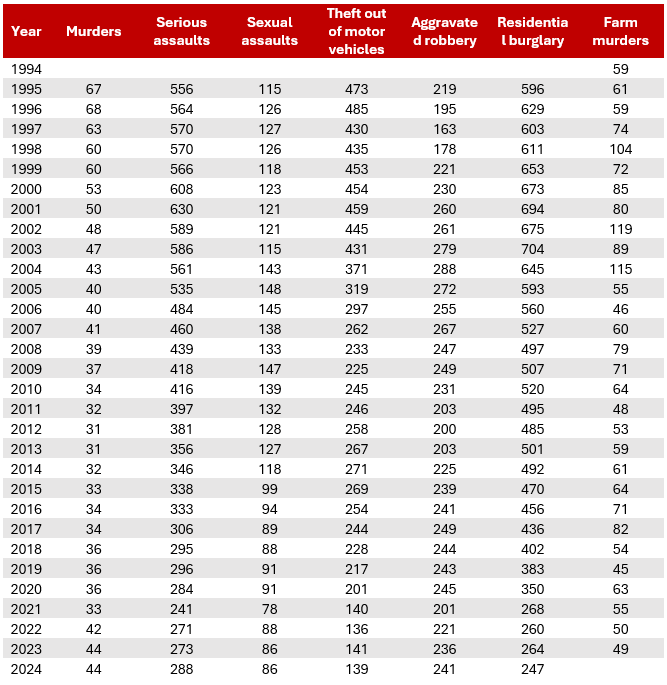
This annexure contains the underlying crime, population and policing data series referenced in the report, enabling readers to verify figures, examine year-by-year trends and replicate the analysis.

- - - - - - - - - - - - - - - - - - - - - - - - - - - - - - - - -

This report has been published by the Inclusive Society Institute
The Inclusive Society Institute (ISI) is an autonomous and independent institution that functions independently from any other entity. It is founded for the purpose of supporting and further deepening multi-party democracy. The ISI’s work is motivated by its desire to achieve non-racialism, non-sexism, social justice and cohesion, economic development and equality in South Africa, through a value system that embodies the social and national democratic principles associated with a developmental state. It recognises that a well-functioning democracy requires well-functioning political formations that are suitably equipped and capacitated. It further acknowledges that South Africa is inextricably linked to the ever transforming and interdependent global world, which necessitates international and multilateral cooperation. As such, the ISI also seeks to achieve its ideals at a global level through cooperation with like-minded parties and organs of civil society who share its basic values. In South Africa, ISI’s ideological positioning is aligned with that of the current ruling party and others in broader society with similar ideals.
Email: info@inclusivesociety.org.za
Phone: +27 (0) 21 201 1589


I like organizations that focus on strengthening democratic participation through education and dialogue. Building capable institutions and encouraging cooperation across different groups is important for creating long-term social progress. Reading about initiatives like this reminds me that collaboration often leads to the best outcomes, whether in public life or in communities built around interests like Eaglercraft, a browser-based sandbox game inspired by Minecraft.